“For research use only” designates a product built for laboratory research, never for diagnosing a patient or dosing a person or animal. That status isn’t fixed by the words on the label. It depends on the product’s real research phase, the absence of diagnostic claims, and the seller’s actual conduct, all governed by 21 CFR 809.10 and FDA guidance on RUO distribution.
TL;DR:
- Products labeled as research use only remain in that status only if they are genuinely in a research phase and not promoted or sold for clinical or diagnostic purposes.
- Regulators scrutinize actual marketing, sales records, and customer communication to determine whether a product still qualifies for RUO exemption, beyond just the label wording.
- Maintaining detailed, consistent documentation, including certificates of analysis and appropriate labeling across all platforms, is crucial to support RUO status and avoid misbranding.
- Peptides sold as RUO pose higher safety and quality risks because impurities and manufacturing variability can lead to unreliable or unsafe experimental results.
- Choosing suppliers that provide full traceability, independent purity verification, and batch-specific certificates significantly reduces risks and helps maintain compliance.
Table of Contents
- What “For Research Use Only” Means in Practice
- Regulatory Criteria That Preserve RUO Status
- Intended Use vs. Label Text: How Enforcement Actually Happens
- Labeling and Documentation Best Practices for Compliant RUO Materials
- Evaluating Suppliers and Safety Implications for Peptides
- How Blank Peptides Aligns With RUO Best Practices
- A Compliance Culture Starts Before the Order Ships
- Source Compliant RUO Peptides With Full Documentation
- Sources
What “For Research Use Only” Means in Practice
The label covers a wide swath of laboratory life: reagents, instruments, assay kits, even software used to process research data. Any of these can carry the RUO designation as long as they’re genuinely still in a research phase and not dressed up as a validated diagnostic tool.
What does RUO actually buy a manufacturer? Mainly an exemption from IVD premarket review and from the quality system regulations in Part 820 that apply to cleared diagnostics. That’s a real regulatory break, but it isn’t a blank check. Basic labeling honesty rules still apply, and so do general product safety obligations. A reagent labeled RUO still has to accurately describe its identity, quantity, and handling requirements.
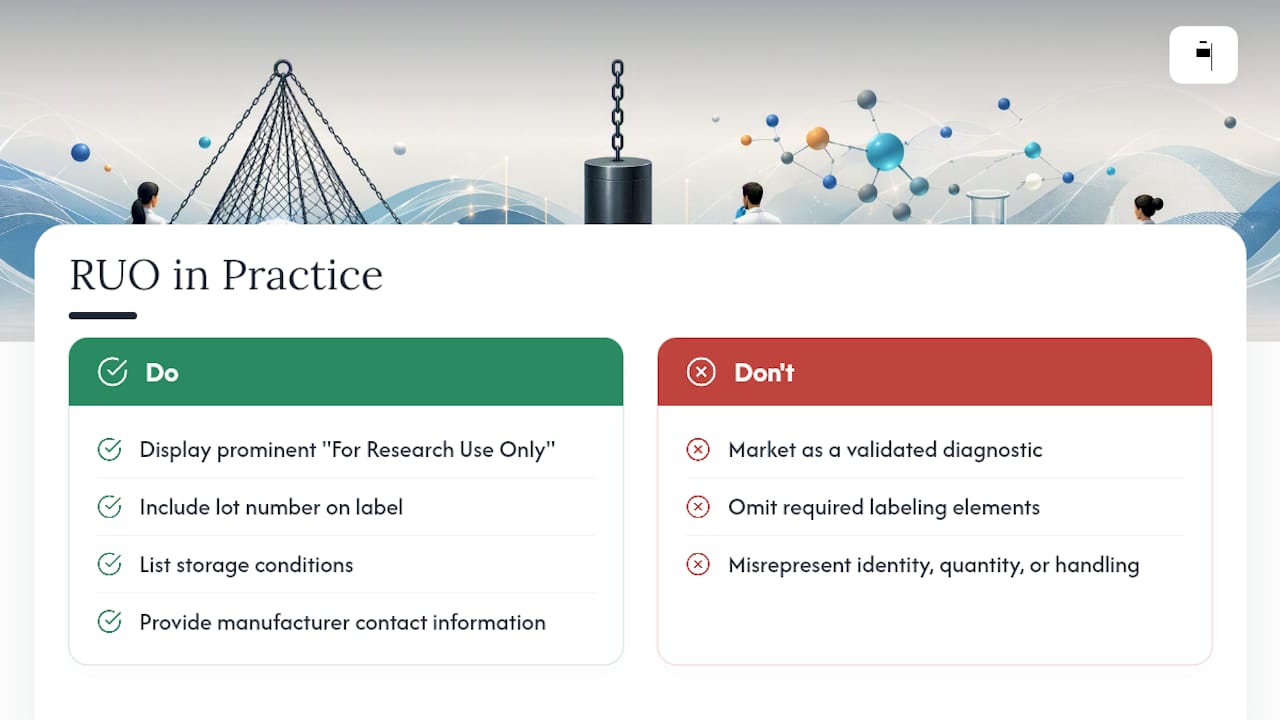
At minimum, expect these labeling elements on a compliant RUO product: the prominent “For Research Use Only” statement (often paired with “Not for use in diagnostic procedures”), lot number, storage conditions, and manufacturer contact information. Strip any of that away and you’ve got a labeling problem before you’ve even reached the intended-use question.
Regulatory Criteria That Preserve RUO Status
Three conditions have to hold simultaneously for a product to keep its RUO exemption under 21 CFR 809.10:
- The product must actually be in the laboratory research phase, not a finished product masquerading as one.
- It cannot be represented as an effective diagnostic tool, in labeling, marketing, or sales conversations.
- It must carry the prominent RUO statement required by the regulation.
Miss any one of these and the product becomes misbranded, regardless of what the box says.
FDA’s guidance on distributing IVD products labeled RUO or IUO fills in the practical detail the regulation leaves open. The Agency doesn’t take the label at face value. It reconstructs intended use from the whole record: website copy, sales literature, instructions for use, technical support scripts, and who actually bought the product. A reagent can say “research use only” on the vial and still get treated as a diagnostic device if the manufacturer’s sales team is pitching it for patient testing.
That reconstruction process means documentation matters as much as the label itself. Regulators reviewing RUO status typically want to see sales records showing who purchased the product, marketing materials matched against actual product use, customer support logs, and any technical literature distributed alongside the product. Keep those records clean and consistent with a research-only narrative, or the label becomes irrelevant.
Intended Use vs. Label Text: How Enforcement Actually Happens
Regulators and courts don’t stop at the label. They look at what a company actually communicates and to whom, and that’s usually where RUO status quietly unravels. Evidence they weigh includes website language describing clinical applications, instructions written for patient-facing use, and shipment records showing sales to clinical labs rather than research institutions.
Warning letters follow a recognizable pattern. In one representative case, FDA cited Agena Bioscience for RUO-labeled products where other materials pointed toward clinical use. The consequences of that mismatch can escalate quickly:
- A warning letter demanding corrective action within a set timeframe.
- Product seizure or injunction if the response is inadequate.
- Civil penalties tied to misbranding violations.
- Pressure to pursue a 510(k) clearance or PMA before continuing sales.
Pro Tip: Run a quarterly audit comparing your marketing copy, technical support scripts, and shipment destinations against your RUO claims. Inconsistency between those three is exactly what shows up in enforcement records.
Watch for these red flags internally: sales reps fielding questions about “patient results,” support staff offering dosing guidance, or a customer list skewed heavily toward clinics rather than labs.
Labeling and Documentation Best Practices for Compliant RUO Materials
The RUO statement belongs in more than one place. Put it on the vial, the outer carton, the technical datasheet, and the product page online. One prominent disclaimer on a shipping box and silence everywhere else invites the same scrutiny as no disclaimer at all.
Documentation should include a certificate of analysis for every batch, a traceable lot number, and a clear statement of the testing methods used. Buyers should be able to connect a specific lot back to its testing data without a phone call.
- State research-only intent on every customer-facing surface, not just the physical label.
- Keep dosing schedules, administration routes, and clinical outcome language off product pages entirely.
- Train technical support staff to redirect any question that assumes human or animal administration.
Pro Tip: If a support ticket includes the word “dose” or “patient,” treat it as a compliance flag, not just a customer service task.
Evaluating Suppliers and Safety Implications for Peptides
Peptides sold as research use only carry sharper risk than a lot of other RUO categories, mainly because purity and sterility failures translate directly into unreliable, and potentially unsafe, results. Researchers commenting on unapproved “research only” peptides have flagged limited human safety data and real manufacturing variability as recurring concerns, particularly for compounds like BPC-157 that circulate widely outside regulated channels.
Before ordering from any supplier, request:
- A certificate of analysis naming the test method (HPLC or mass spectrometry), the acceptance criteria, and the actual measured purity.
- Sterility testing data where relevant to the compound.
- Confirmed manufacturing location and batch traceability back to a retained sample.
US-based manufacturing and independent third-party verification aren’t marketing flourishes here. They’re the difference between a reproducible result and a wasted experiment. A supplier hiding disclaimers in fine print, publishing consumer dosing charts, or unable to produce a COA on request is telling you something about how seriously they treat the RUO line.
How Blank Peptides Aligns With RUO Best Practices
Blankpeptides builds its catalog around the same standards this article just laid out, not as an afterthought but as the operating model.
- USA-based manufacturing with documented batch traceability
- Independent purity verification for every production run
- COAs available for every batch, not a sampled subset
- A catalog built specifically around research-only use, including KISSPEPTIN, BPC-157 capsules, and CJC-1295 / Ipamorelin
That combination directly addresses the sourcing risks described above: unverifiable purity, missing traceability, and suppliers who treat COAs as optional.
A Compliance Culture Starts Before the Order Ships
Conservative communication beats clever marketing every time in this category. Strong traceability, a COA on file for every lot, and support staff trained to redirect clinical-sounding questions will save a lab more headaches than any legal disclaimer. Assign one person to verify incoming COAs against your own acceptance criteria, and put storage and procurement sign-off in writing before the next order goes out.
— Blank Research Team
Source Compliant RUO Peptides With Full Documentation
Blankpeptides gives labs what a lot of RUO suppliers treat as optional: a COA for every single batch, US manufacturing you can trace to a specific facility, and purity verification that doesn’t depend on taking a seller’s word for it.
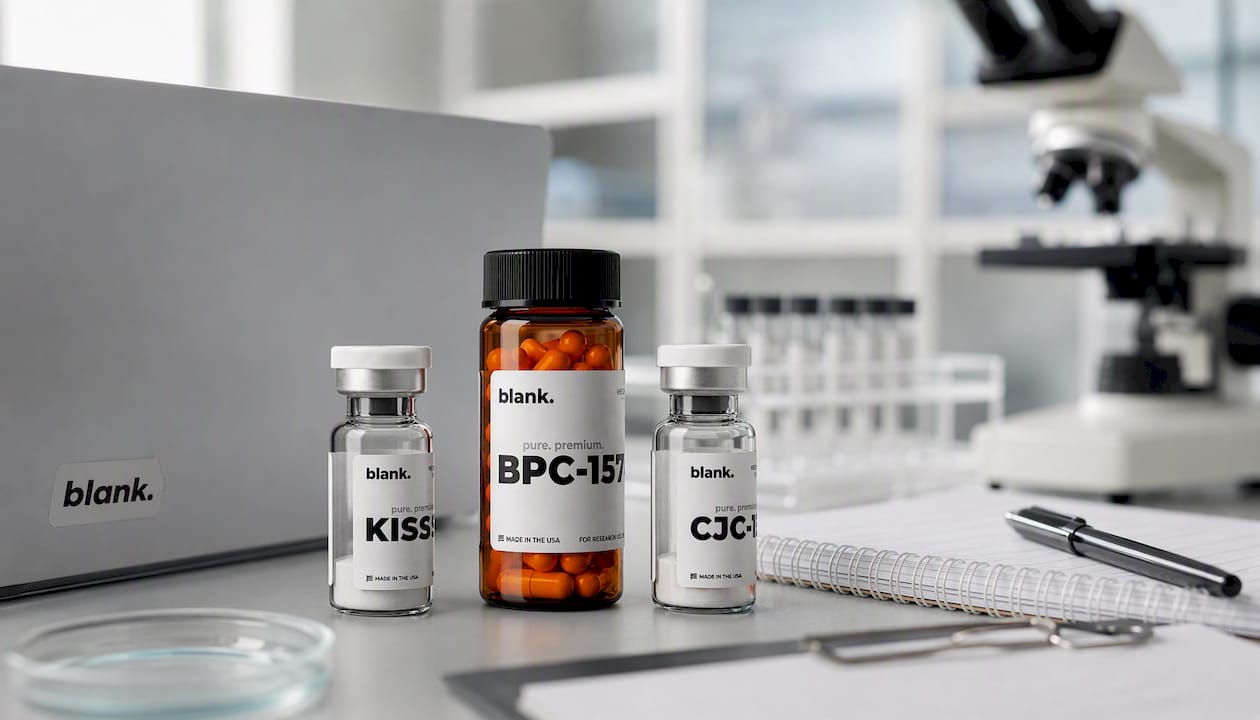
If your lab has been burned by a supplier who couldn’t produce documentation on request, or who buried the RUO disclaimer somewhere you had to go looking for it, that’s exactly the gap this catalog is built to close. Browse the Kisspeptin research page, the BPC-157 capsule listing, or the CJC-1295 / Ipamorelin product page, and request a current COA before you place your first order. Institutional buyers can also reach out directly for account terms and bulk procurement details.