Peptide contamination means any unwanted substance in a peptide product that isn’t the intended sequence at stated purity, most dangerously endotoxin, heavy metals, or cross-contaminating peptides left over from shared manufacturing lines. Each poses a distinct threat: endotoxin drives inflammatory responses, metals carry cumulative toxicity, and stray peptides can quietly wreck an immune assay. Before using any lot in cell-based or in vivo work, check the certificate of analysis and, when the stakes are high, commission independent orthogonal testing rather than trusting the label alone.
TL;DR:
- Most contamination issues stem from residual synthesis chemicals, cross-contact on shared equipment, and improper handling after production, not just from initial manufacturing.
- Independent testing methods such as HRMS, LAL, ICP-MS, and headspace GC reveal impurities that standard HPLC purity checks often miss, especially for endotoxin and heavy metals.
- Relying solely on a single purity percentage causes misinterpretation, as it ignores factors like residual counter-ions and actual peptide content critical for accurate dosing.
- Picking suppliers that provide verified, comprehensive COAs and practicing rigorous reconstitution and storage protocols dramatically reduce contamination risks.
- Promptly halting use and conducting orthogonal testing are essential if unexpected assay results or toxicity suggest peptide contamination.
Table of Contents
- Major Contaminant Types in Synthetic Peptides
- How Contamination Happens: Manufacturing and Handling Failure Points
- How Contamination Is Detected: HPLC, MS, LAL, ICP-MS, and GC
- How to Read a COA and Interpret Purity Claims
- Risks and Impacts: Assay Artifacts and Human Safety Concerns
- Prevention and QA/QC Checklist for Buyers and Labs
- Immediate Actions If You Suspect Contamination
- How the Blank Research Team Tests for and Prevents Contamination
- Synthetic Peptides vs. Biologics: Different Contamination Risks
- Contamination Incidents: What Went Wrong and How They Got Resolved
- Why Blankpeptides Backs Every Lot With Independent Verification
- Where the Real Risk Sits
- Sources
- FAQ
Major Contaminant Types in Synthetic Peptides
Not all contamination behaves the same way, and that’s the first thing researchers get wrong. A solvent residue and a bacterial endotoxin might both show up as “impurities” on paper, but they fail differently, get missed by different tests, and cause completely different downstream problems.
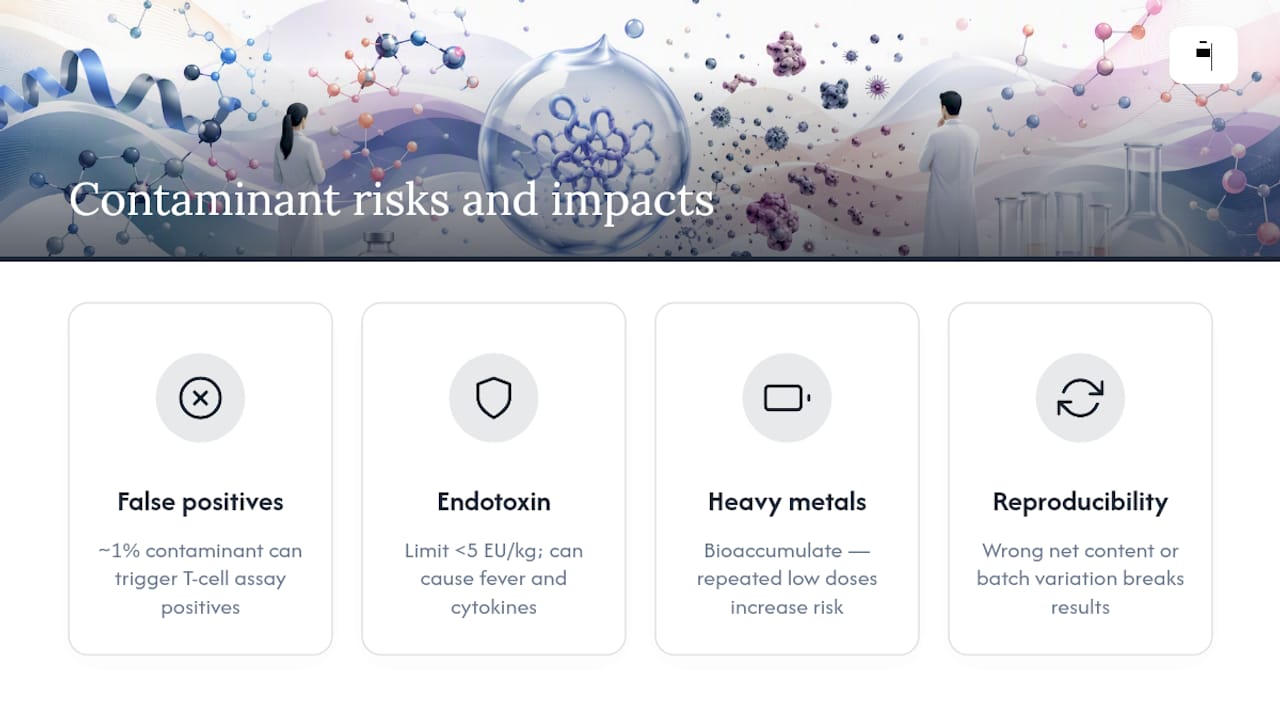
Endotoxins are lipopolysaccharide fragments shed from the outer membrane of gram-negative bacteria, and they are the single most consequential contaminant class in peptide research. They survive standard autoclaving because they’re heat-stable up to temperatures that destroy the bacteria themselves. In cell culture, even trace endotoxin activates Toll-like receptor 4 signaling and skews cytokine readouts. In animal work, it can trigger fever, hypotension, or septic-shock-like responses depending on dose and route. Guidance on endotoxin limits commonly references thresholds under 5 EU/kg body weight as a general safety benchmark for preclinical applications, though the appropriate limit depends heavily on route of administration and study design.
Heavy metals enter peptide products mainly through reagents, resin, or metal catalysts used during synthesis and purification. Lead, cadmium, arsenic, and mercury are the usual suspects, and they don’t need to be present in large amounts to matter. These elements accumulate in tissue over repeated exposure, and even parts-per-million levels can confound toxicology studies or introduce unexplained variability into dose-response curves.
Residual solvents and counter-ions are a subtler problem. Trifluoroacetic acid (TFA), used almost universally in solid-phase peptide synthesis cleavage and purification, doesn’t just risk toxicity at high concentration. It binds to the peptide as a counter-ion, adding mass that inflates the “as-is” weight of a vial without adding any actual peptide. Acetonitrile, dichloromethane, and other cleavage-related solvents can also linger if lyophilization and drying steps are rushed.
Peptidic contaminants are arguably the hardest to catch and the most consequential for immunology work. These include:
- Truncated sequences from incomplete coupling steps during synthesis
- Deletion peptides missing one or more residues
- Racemized amino acids that alter three-dimensional structure without changing molecular weight
- Cross-contaminating peptides from other products run on the same synthesis or purification equipment
That last category deserves special attention. Case studies have shown that cross-contamination at roughly 1% by weight can generate false-positive T-cell assay results, because T cells recognize antigens at subnanomolar concentrations. A contaminant too small to register on a standard HPLC trace can still be biologically active enough to derail an immunogenicity study.
Degradation products round out the list: oxidation of methionine or cysteine residues, deamidation of asparagine and glutamine, and dimerization through disulfide bond formation. None of these happen during synthesis. They happen afterward, during storage, shipping, or repeated freeze-thaw cycles, which is why handling matters almost as much as manufacturing.
How Contamination Happens: Manufacturing and Handling Failure Points
Contamination rarely enters through one dramatic failure. It usually creeps in through a sequence of small, ordinary lapses across the production and handling chain. Mapping those failure points is the fastest way to figure out where your own risk actually lives.
Synthesis-stage residues. Solid-phase peptide synthesis (SPPS) relies on repeated coupling and deprotection cycles, and the final cleavage step uses strong acids like TFA to release the peptide from its resin. Incomplete washing after cleavage leaves behind resin fragments, scavengers, and solvent residue. Rushed or incomplete coupling cycles also generate truncated and deletion sequences that end up alongside the target peptide in the crude mixture.
Shared equipment and inadequate changeover. Many contract manufacturers run multiple peptide products through the same synthesizers, HPLC columns, and lyophilizers. Without rigorous, validated cleaning protocols between batches, trace residue from one peptide transfers to the next. This is almost certainly the leading mechanism behind the cross-contamination cases documented in peer-reviewed impurity studies, where a supposedly pure vial contained enough of a second peptide to skew an assay.
Water systems as a silent vector. Endotoxin is widely distributed in ordinary water and glassware, and any water system that isn’t validated for endotoxin control becomes a continuous contamination source rather than a one-time event. Facilities without water-for-injection-grade systems, or without routine endotoxin monitoring of their process water, are working with an invisible baseline risk.
Filling and lyophilization gaps. Even a perfectly pure bulk peptide can pick up contamination during vial filling if the fill environment isn’t properly controlled, or during freeze-drying if the lyophilization cycle allows moisture retention that later promotes degradation.
Storage and reconstitution handling. This is where the manufacturer’s job ends and the researcher’s begins. Reconstituting a lyophilized peptide with non-sterile water, using non-depyrogenated glassware, or leaving reconstituted material at room temperature for extended periods introduces contamination that no COA will ever catch, because it happens after testing.
Lot-to-lot variability and monitoring gaps. Facilities without robust environmental monitoring programs, or without statistical tracking of lot-to-lot variation, can miss the early warning signs of a drifting process long before a batch fails outright.
Every one of these failure points is auditable. A supplier who can walk through their changeover validation, water system monitoring, and fill-room controls is telling you something concrete about where they’ve closed these gaps. One who can’t is asking you to trust the finished COA on faith alone.
How Contamination Is Detected: HPLC, MS, LAL, ICP-MS, and GC
No single test catches everything, which is the central fact that trips up researchers who assume a high purity number on a label settles the question. Detecting peptide contamination properly means matching each contaminant class to the analytical method built to find it.
Reverse-phase HPLC (RP-HPLC) is the workhorse for chromatographic purity. It separates the target peptide from related impurities based on hydrophobicity and reports purity as a percentage of total peak area. It’s fast, quantitative, and standard across the industry, but it has a real blind spot: two different molecules can co-elute at nearly the same retention time, meaning a clean-looking single peak can still hide a contaminant that HPLC alone can’t resolve.
Mass spectrometry, especially high-resolution MS (HRMS), closes that gap by confirming molecular identity rather than just retention behavior. Recent UHPLC-HRMS work on peptide pools found that reanalysis routinely turns up impurities like oxidation products, dimers, and deletion peptides that a standard HPLC trace missed entirely. Some of these, cysteine dimers in particular, are present at low levels but remain biologically significant enough to affect assay outcomes.
LAL testing (Limulus Amebocyte Lysate) is the standard method for detecting endotoxin, reported in endotoxin units per milligram (EU/mg). This is the test most researchers skip, and it’s the one that matters most for anything touching live cells or animals. Guidance documents commonly reference limits below 5 EU/kg body weight as a general preclinical safety threshold, though the appropriate cutoff depends on dosing route and study protocol.
ICP-MS or ICP-OES (inductively coupled plasma mass spectrometry or optical emission spectroscopy) detects heavy metals down to parts-per-billion sensitivity, screening simultaneously for lead, arsenic, cadmium, mercury, and residual synthesis catalysts like palladium or copper.
Headspace GC (gas chromatography) identifies and quantifies residual solvents like acetonitrile, dichloromethane, and TFA left over from synthesis and purification.
The orthogonal testing principle: No single analytical method characterizes a peptide completely. Pharmacopeial guidance on synthetic peptide therapeutics recommends combining multiple techniques, HPLC, mass spectrometry, amino acid analysis, and reference-standard comparison, because each method has distinct blind spots that the others cover.
Here’s what a genuinely orthogonal testing panel looks like in practice:
- RP-HPLC for chromatographic purity percentage
- HRMS for molecular identity confirmation and unexpected mass detection
- LAL assay for endotoxin quantification in EU/mg
- ICP-MS for heavy metal screening
- Headspace GC for residual solvent quantification
- Amino acid analysis or nitrogen determination for absolute peptide content
Pro Tip: Don’t assume every application needs the full panel. Reserve ICP-MS and full endotoxin testing for material headed into cell-based assays or animal studies, and lean on HPLC plus MS confirmation for routine bench comparisons. Matching testing depth to actual risk keeps costs sane without leaving blind spots where they matter.
The gap between what a basic HPLC certificate tells you and what a full orthogonal panel reveals isn’t small. It’s the difference between knowing a peptide looks pure and knowing what’s actually in the vial.
How to Read a COA and Interpret Purity Claims
The single most common mistake in peptide procurement is treating “purity” as one number when it’s actually at least two.
HPLC area percent tells you what fraction of the detected peak area belongs to your target peptide relative to everything else that eluted. It says nothing about how much total peptide mass is actually in the vial. Net peptide content (sometimes called absolute peptide content) is the figure that actually matters for dosing: it accounts for moisture, residual salts, and counter-ions that make up real physical weight without contributing any peptide.
This distinction matters because of TFA. Since TFA is used throughout synthesis and purification, it often remains bound to the peptide as a counter-ion, and it can account for a meaningful share of a vial’s total weight. Independent purity analyses have flagged this exact confusion as one of the most common misreadings in the research peptide space.
A COA worth trusting includes:
- An HPLC trace with visible peak resolution, not just a summary percentage
- Mass spectrometry confirmation of molecular identity, ideally with observed versus expected mass
- Endotoxin testing results reported in EU/mg
- Heavy metal screening data (ICP-MS or ICP-OES)
- Residual solvent quantification
- Moisture content, which directly affects net peptide content calculations
- Net peptide content, not just area percent
If a COA shows only a single HPLC percentage with no mass spec, no endotoxin data, and no moisture figure, that’s a red flag worth escalating. Ask the supplier directly for net peptide content and, if the material is headed into any biological assay, request independent verification data rather than relying on the manufacturer’s internal testing alone. Pharmacopeial reference standards and multi-laboratory value assignment exist precisely because single-lab purity claims carry more uncertainty than most researchers assume.
Risks and Impacts: Assay Artifacts and Human Safety Concerns
Contamination doesn’t just make a peptide “less pure.” It changes what an experiment actually measures, and in clinical or self-administered contexts, it introduces real physiological risk.
Documented cases of peptide cross-contamination have produced false-positive results in T-cell response assays at contaminant levels around 1% by weight, low enough to pass most routine QC checks but high enough to activate immune signaling. T cells respond to antigen at subnanomolar concentrations, so a contaminant invisible to standard biochemical screening can still be biologically potent. That gap between “looks clean” and “acts clean” is the central hazard of relying on chromatographic purity alone.
Independent laboratory analyses have repeatedly found research-grade peptide vials with mislabeling, underdosing, overdosing, or unlisted contaminants including heavy metals, endotoxin, and residual solvents, prompting regulators to scrutinize how loosely some of this material is currently sold and tested.
Endotoxin exposure carries the clearest safety framework of any contaminant class. General preclinical safety guidance points to limits under 5 EU/kg body weight, and exceeding that threshold in animal studies can trigger fever, inflammatory cytokine release, or hypotensive responses depending on dose and administration route. In cell culture, endotoxin contamination is a well-known confounder that inflates inflammatory marker readouts and can make an otherwise inert compound look immunostimulatory.
Heavy metal contamination behaves differently: it’s cumulative rather than acute. Lead and cadmium in particular bioaccumulate, meaning repeated low-level exposure across multiple studies or multiple self-administered doses carries more risk than any single exposure event would suggest.
Beyond acute safety, contamination corrodes the thing researchers actually care about most: reproducibility. A peptide with unknown net content, because counter-ion mass wasn’t accounted for, means your calculated dose response curve is built on a wrong denominator from the start. Batch-to-batch contamination variability means a protocol that worked with one lot may silently fail, or produce different results, with the next. Every one of these problems traces back to the same root cause: trusting a label without independently verifying what’s actually behind it.
Prevention and QA/QC Checklist for Buyers and Labs
Preventing contamination is cheaper and more reliable than trying to detect and correct it after the fact, especially with endotoxin, which is heat-stable and difficult to remove once it’s bound to a peptide or embedded in glassware. The priority order below reflects where the highest-leverage interventions sit.
Vet your supplier before you place an order. Ask specifically whether COAs are generated in-house only or independently verified by a third-party lab. Ask about manufacturing location, changeover validation between different peptide products, and whether water systems are monitored for endotoxin. A supplier who answers these questions specifically and quickly is telling you something different than one who deflects to generic purity claims.
Verify on receipt, don’t just file the COA. At minimum, confirm the vial matches its label visually (lyophilized cake appearance, color, volume) and cross-check the lot number against the COA provided. For anything going into a cell-based assay or animal study, escalate to independent LAL testing, ICP-MS metals screening, or HRMS confirmation, particularly for new suppliers or unexpected experimental results.
Control handling and storage rigorously. Reconstitute only with certified endotoxin-free, sterile water. Use depyrogenated glassware for anything touching cell culture or in vivo work. Minimize freeze-thaw cycles, since repeated cycling accelerates oxidation, deamidation, and aggregation.
Push suppliers on their internal controls. Validated equipment cleaning between batches, documented water system monitoring, and lot traceability aren’t nice-to-haves, they’re the mechanical reasons contamination does or doesn’t happen upstream of your order.
Understand contamination removal tradeoffs. Techniques like polymyxin B affinity columns, Triton X-114 phase separation, or activated carbon treatment can strip endotoxin from an already-contaminated batch, but they typically cause nonspecific peptide loss and require careful post-treatment cleanup. These are corrective measures for specialized workflows, not a substitute for sourcing clean material in the first place.
Pro Tip: Keep a simple risk-tiering system for incoming lots: routine bench comparisons get a COA check and visual inspection; anything touching cells or animals gets full orthogonal testing before it goes near an assay. A risk-based testing approach that scales scrutiny to actual use case balances cost against safety far better than testing everything identically or testing nothing at all.
The through-line across all five steps is the same: contamination prevention is a chain, and it’s only as strong as its weakest link, whether that link sits in the manufacturer’s cleaning validation or your own bench-side reconstitution technique.
Immediate Actions If You Suspect Contamination
If a lot behaves unexpectedly, contaminated glassware appearance, unusual assay results, unexplained toxicity in animal work, move fast and methodically rather than assuming the worst or dismissing it as noise.
- Hold the lot immediately. Stop using the material and document chain of custody: when it was received, how it was stored, and every condition it’s been exposed to since arrival.
- Run orthogonal testing on retained material. Compare results directly against the original COA. If you retained a sample from the same lot, HRMS and LAL testing will tell you quickly whether the discrepancy is real or a handling artifact on your end.
- Contact the supplier and request independent retesting. A credible supplier will cooperate with a retest request or offer replacement material without resistance; reluctance here is itself useful information.
- Watch for clinical red flags in anyone exposed to the material. Fever, unusual inflammatory response, or systemic symptoms following exposure to a suspect lot warrant prompt medical evaluation rather than a wait-and-see approach.
Acting on the first sign of trouble, rather than waiting for a pattern to emerge across multiple experiments, is what separates a contained incident from a wasted study and a genuine safety event.
How the Blank Research Team Tests for and Prevents Contamination
Blankpeptides runs every batch through the same orthogonal logic outlined above rather than relying on a single purity number. That means HPLC for chromatographic purity, mass spectrometry for identity confirmation, and dedicated testing for endotoxin, heavy metals, and moisture content before a lot ever ships.
Manufacturing happens in US-based facilities, and every batch undergoes independent verification rather than only internal testing, addressing a common issue found in the broader research peptide market. The goal is straightforward: a researcher should be able to trust the number on the label because it’s been checked by someone other than the company that made the claim.
What this looks like in practice for researchers:
- COAs are available for every batch, not just on request for select products
- Purity across the catalog targets high levels, verified independently rather than self-reported
- Researchers can request sample testing data or technical consultation before committing to a larger order
- Lot traceability means a specific batch’s testing data can be pulled and reviewed on demand
That transparency is the entire point. A COA that nobody can verify independently is just a claim with a letterhead.
Synthetic Peptides vs. Biologics: Different Contamination Risks
Synthetic peptides and biologics fail in different ways, which is why the same QC checklist doesn’t transfer cleanly between them. Synthetic peptides, built through solid-phase chemical synthesis, carry contamination risks tied to chemistry: residual TFA and counter-ions, incomplete coupling producing truncated sequences, racemization during synthesis, and cross-contamination from shared synthesizer equipment running multiple peptide products.
Biologics, produced in living cell systems (bacterial, yeast, or mammalian expression), face an entirely different risk profile. Host cell protein residues, DNA fragments from the expression system, viral contamination risk, and batch-to-batch variability from biological production all sit outside the concerns synthetic chemistry introduces. Endotoxin is a shared risk across both categories, since gram-negative bacterial contamination can occur in bacterial expression systems for biologics just as easily as it can occur through contaminated water or glassware in synthetic peptide handling.
The practical implication for researchers: don’t assume a QC checklist built for recombinant proteins covers synthetic peptide risks, or vice versa. A biologic’s COA needs host-cell-protein and viral clearance data that a synthetic peptide’s COA doesn’t require, while a synthetic peptide’s COA needs counter-ion and racemization data that a biologic’s doesn’t. Applying the wrong checklist to the wrong product category is a common and avoidable gap in procurement review.
Contamination Incidents: What Went Wrong and How They Got Resolved
The clearest documented example of peptide contamination causing real experimental harm comes from vaccine research, where peer-reviewed analysis of commercial synthetic peptides found cross-contaminating peptides at roughly 1% by weight generating false-positive T-cell assay results. The resolution path in that case involved switching to orthogonal testing, specifically mass spectrometry confirmation alongside HPLC, to catch contaminants that chromatographic purity checks alone had missed. The broader lesson adopted since: biochemical purity checks and biological activity checks need to run in parallel, not sequentially.
On the supply side, investigative reporting into research-grade peptide vials found a pattern of mislabeling, underdosing, overdosing, and undisclosed contaminants including heavy metals and endotoxin across products sold with minimal independent oversight. The resolution here has been regulatory rather than technical: increased scrutiny from oversight bodies evaluating how these products are labeled, tested, and sold, alongside a growing expectation that legitimate suppliers publish independently verified COAs rather than self-reported purity figures.
Both cases point to the same fix: independent verification catches what internal testing alone misses, whether the failure shows up in an assay or in a vial on a lab bench.
Why Blankpeptides Backs Every Lot With Independent Verification
Most of the contamination problems documented in independent investigations trace back to one root cause: nobody outside the manufacturer checked the claim before it reached the buyer. Blankpeptides closes that gap by pairing USA-based manufacturing with independent lab verification and a COA on every single batch, not just flagship products.
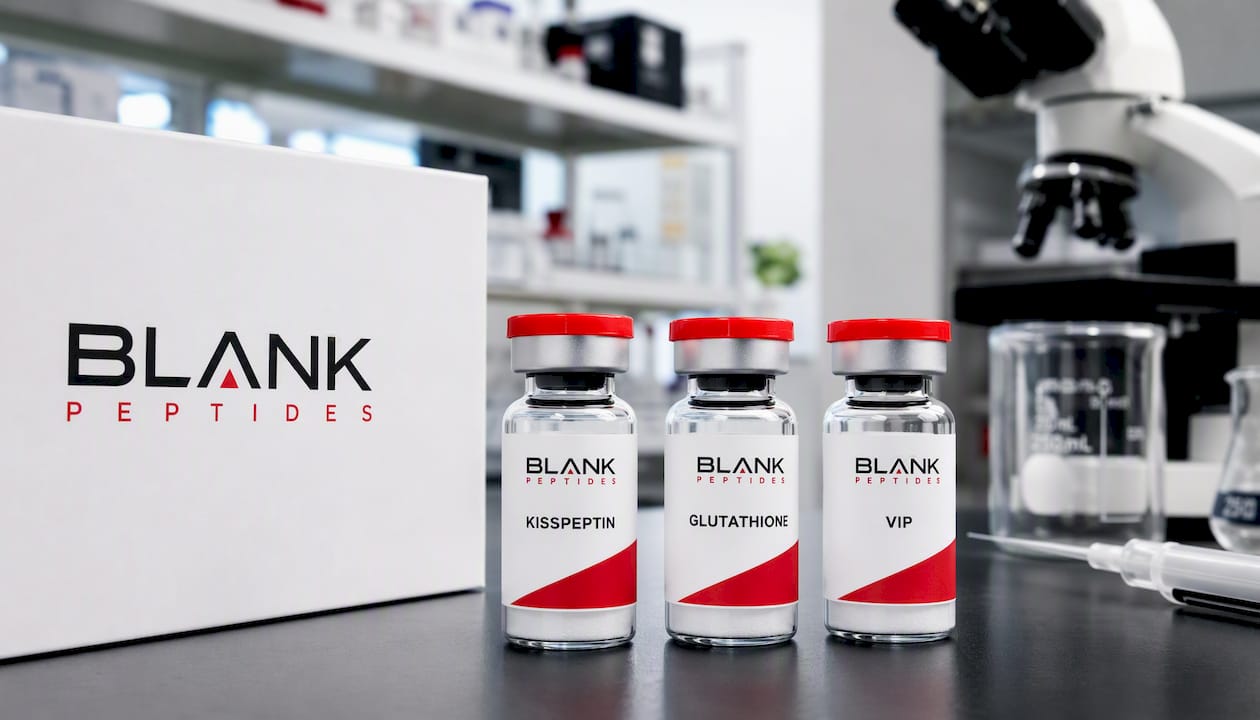
The current catalog includes KISSPEPTIN, SEMAX, GLOW, BPC-157 capsules, VIP, and DSIP, each shipped with independently verified purity above 99%, HPLC and mass spec confirmation, and endotoxin, metals, and residual solvent data on file. Researchers who need the full testing panel before committing to a larger order can request COA documentation or sample testing directly, rather than taking a purity percentage on faith.
If your work depends on knowing exactly what’s in the vial, start by pulling the COA for the specific product and lot you need, and reach out for technical consultation if your assay calls for verification beyond the standard panel.
Where the Real Risk Sits
Most contamination discussions fixate on flashy numbers, purity percentages, parts-per-billion metal thresholds, while skipping the boring failure points that actually cause harm: rushed cleaning validation between batches, water systems nobody’s monitoring, reconstitution done with the wrong water. The technical fixes are well understood. What’s underestimated is how often the gap sits in handling after a clean product leaves a legitimate manufacturer.
Reproducibility problems that get blamed on biological variability are, often enough, contamination problems nobody tested for. That’s not a reason for paralysis. It’s a reason to size testing to actual risk, and to stop treating a single HPLC percentage as the whole story.
— Blank Research Team
Sources
- Peptide impurities in commercial synthetic peptides and their implications for vaccine trial assessment | PMC
- Doctors flag risks, contamination as FDA panel weighs loosening restrictions | NBC Washington
- New FDA Q&As on endotoxin testing | GMP Compliance
- Reference standards to support quality of synthetic peptide therapeutics | USP
- UHPLC–HRMS impurity profiling of peptide pools (Separations, 2025)
FAQ
Are peptides being banned?
Regulatory bodies have scrutinized certain research peptides over safety and manufacturing concerns rather than issuing blanket bans across the category. Oversight has tightened specifically around products sold with inadequate testing or unclear labeling, which is part of why regulators are examining loosened restrictions carefully rather than broadly.
Why are some doctors cautious about injectable peptides?
Caution centers on documented quality problems in the unregulated research peptide market, including mislabeling, incorrect dosing, and unlisted contaminants like heavy metals and endotoxin. Without independent verification, there’s no reliable way to confirm what’s actually in a given vial before it’s used.
How do I know if a peptide has degraded or gone bad?
Visual cues include cloudiness, discoloration, or a lyophilized cake that has collapsed or changed texture, though degradation isn’t always visible. The more reliable check is testing: HPLC purity comparison against the original COA, plus mass spec confirmation, can reveal oxidation, deamidation, or dimer formation that occurred during storage.
What are the real dangers of contaminated peptides?
The main risks are endotoxin-driven inflammatory responses, cumulative heavy metal toxicity, and cross-contaminating peptides that can trigger false immune assay results even at levels around 1% by weight. These risks apply to both experimental validity and, in cases involving human exposure, direct physiological safety.
How does Blankpeptides confirm its peptides are contamination-free?
Every batch goes through HPLC and mass spectrometry testing alongside endotoxin, heavy metal, and residual solvent screening, with results independently verified rather than self-reported. Researchers can request the COA for a specific lot directly from Blankpeptides before placing an order.