Research-grade growth hormone peptides are synthetic GH secretagogues and analogs sold strictly for in vitro and preclinical laboratory use, never for human administration. The procurement rule that matters most: never accept a batch without a Certificate of Analysis showing HPLC purity, net peptide content, and endotoxin data if the peptide is going into cell culture. Blank Peptides documents all three for every batch, manufactured in the USA.
TL;DR:
- Always verify that peptide batches come with a detailed Certificate of Analysis that includes chromatograms, mass spectrometry data, and matching batch numbers.
- Use a purity threshold of at least 98% for cell-based assays or receptor studies, and 99% for structural or dose-response research; consider net peptide content alongside purity.
- Confirm endotoxin levels are below 1 EU/mg for standard cell work or under 0.1 EU/mg for sensitive immune assays to avoid assay interference.
- Log batch-specific COAs and verify identity, purity, and endotoxin data before running experiments, especially for critical or publication-grade work.
- Store lyophilized peptides at -20°C or colder, account for net peptide content in dosing calculations, and request independent verification for high-value batches.
Table of Contents
- What a Peptide Certificate of Analysis Actually Tells You
- Matching Purity and Safety Thresholds to Your Experiment
- A Verification Checklist Before You Order or Run a Batch
- Storage and Concentration Math That Accounts for NPC
- What to Prepare Before You Place an Order
- The Case for Making COA Transparency Non-Negotiable
- Where to Find Verified Growth Hormone Peptides for Research
- Sources
What a Peptide Certificate of Analysis Actually Tells You
A real COA is a lab report, not a marketing sheet. It should confirm identity through mass spectrometry, show an actual HPLC chromatogram with a labeled purity percentage, report net peptide content (NPC), list endotoxin and residual solvent results, and carry a batch or lot number tied to a manufacturing date. Each element answers a different question about what’s actually in the vial, and COA sections and chromatograms are standard elements essential for reproducibility.
Some of this is mandatory for any research-grade purchase. Identity confirmation and HPLC purity are non-negotiable. NPC and endotoxin data are situational: critical if you’re running cell-based assays, less urgent for straightforward binding screens, but still worth having on file.
Watch for these red flags before you buy:
- A “high purity” claim with no numerical value attached
- No chromatogram image, just a stated percentage
- A round number like 99.0% with no decimal precision
- No batch number, or a batch number that doesn’t match the product label
- Peptide name on the COA that doesn’t exactly match the catalog listing
Missing chromatograms, generic claims, and suspiciously round purity numbers are recognized signs of an unreliable COA.
Pro Tip: Open the COA before you open the vial. If the PDF has no method section (column type, mobile phase, detection wavelength), the purity number on the front page is basically unverifiable.
Matching Purity and Safety Thresholds to Your Experiment
Purity requirements aren’t universal.
A practical framework:
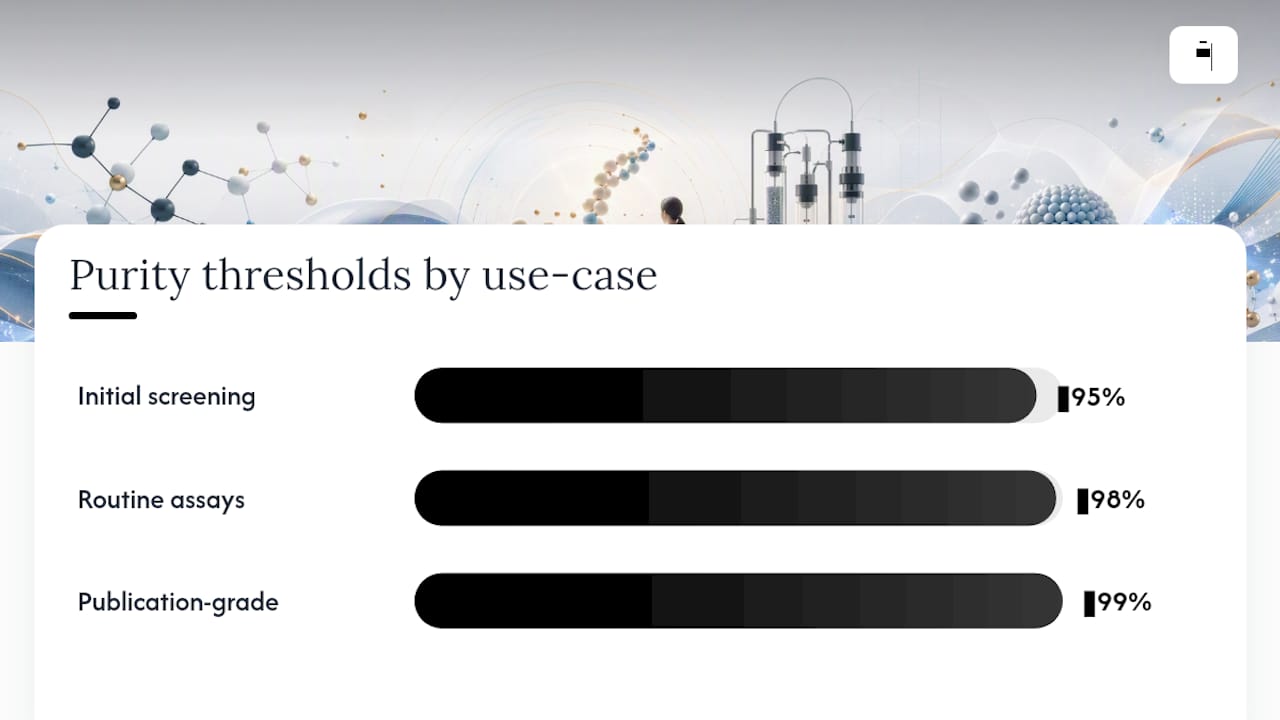
- Initial screening or feasibility work: ≥95% HPLC purity is generally acceptable.
- Routine cell-based assays and receptor-binding studies: ≥98% is the safer floor, since impurities can skew binding kinetics at low concentrations.
- Publication-grade dose-response or structural work: ≥99% is recommended, paired with MS confirmation of exact mass.
These bands align with guidance mapping HPLC purity to research use-cases, and higher purity generally costs more, which is why matching the spec to the actual experiment saves budget without sacrificing data quality.
Net peptide content matters just as much as the purity percentage, arguably more for anyone doing quantitative work. NPC often ranges between 60% and 90% in practice, which means two vials both labeled “10 mg” can deliver meaningfully different actual peptide loads depending on NPC.
Endotoxin thresholds depend on assay sensitivity. General cell culture work typically tolerates endotoxin below 1 EU/mg. Sensitive immunology assays, particularly anything involving immune cell activation, usually need to stay under 0.1 EU/mg. This is where COA gaps get expensive: independent testing found 65% of sampled peptides exceeded safe endotoxin thresholds in one analysis, and a large share of vendor COAs simply omit endotoxin data entirely rather than reporting a failure.
A Verification Checklist Before You Order or Run a Batch
Run this sequence before any batch goes into a protocol:
- Locate the batch-specific COA and confirm the catalog number and lot match exactly what arrived. A COA for the wrong batch is worse than no COA at all.
- Check the HPLC data and MS confirmation. Look for a visible chromatogram, a stated column and detection wavelength, and an intact mass that matches the expected molecular weight.
- Confirm net peptide content and counterion identity. This tells you what you’re actually weighing into your stock solution.
- Request endotoxin data if any cell work is planned. If it’s not on the COA, ask before you buy, not after your assay fails to replicate.
- Consider independent testing for high-value or publication-critical batches. Third-party labs such as Janoshik Analytical typically charge $50 to $150 per sample for HPLC and LC-MS verification, a small cost against a ruined experiment series.
For step 5, prioritize identity confirmation and purity re-testing first; endotoxin re-testing matters most if the vendor’s own data is missing or looks inconsistent with prior batches.
Log every purchase in your methods documentation: vendor name, catalog number, batch/lot number, and COA date. This isn’t paperwork for its own sake. When a reviewer or collaborator asks why a result didn’t replicate, “we sourced from an unverified batch with no traceable COA” is a much worse answer than a clean paper trail.
Pro Tip: Keep a shared lab spreadsheet logging batch numbers against assay outcomes. Patterns in failed replications often trace back to specific lots, not experimental error.
Storage and Concentration Math That Accounts for NPC
Skipping the NPC correction is one of the most common quiet errors in peptide-based cell work.
Practical handling notes:
- Convert gross vial mass to actual peptide mass using the NPC value before preparing any stock solution.
- Store lyophilized peptide at negative 20 degrees Celsius or colder; once reconstituted, aliquot immediately rather than pulling from one tube repeatedly.
- Minimize freeze-thaw cycles. Each cycle risks aggregation or degradation that a fresh HPLC run would catch but your assay won’t tell you about directly.
- Choose solvents and buffers appropriate to the peptide’s solubility profile, and prepare everything under aseptic technique to avoid introducing endotoxin after the fact.
Pro Tip: If your COA lists NPC but not a specific counterion identity (acetate, TFA, etc.), ask before you calculate molarity. Counterion mass varies enough to matter for precise dosing curves.
What to Prepare Before You Place an Order
Most legitimate peptide suppliers require buyers to confirm they’re qualified researchers, often tied to institutional billing, and to attest they’re purchasing for laboratory research only, not human use, with age verification typically set at 21 and older.
Before ordering, have ready:
- Institutional or lab affiliation details for billing and compliance
- A clear research-use attestation
- A request for the batch-specific COA, not a generic product-level COA
- A question about manufacturing origin and quality system (cGMP compliance, for instance)
Blank Peptides documents USA-manufacturing on every product, provides independent verification of purity, and issues a COA for every batch, with a stated commitment to greater than 99% purity across its catalog.
The Case for Making COA Transparency Non-Negotiable
Most procurement failures in peptide research trace back to one habit: trusting a purity claim without reading the method behind it. Blank Peptides built its process around the opposite instinct, treating batch-level COA disclosure and USA-manufacturing as baseline requirements rather than premium features, backed by independent verification and a research base of more than 10,000 researchers who’ve relied on that documentation.
For principal investigators and procurement officers, the actionable takeaway is simple: standardize a COA-request step into every peptide purchase order, and log batch numbers against outcomes so reagent quality becomes visible in your data, not just your invoices.
— Blank Research Team
Where to Find Verified Growth Hormone Peptides for Research
If you’re comparing growth hormone releasing peptides for an upcoming study, Blank Peptides’ catalog gives you three practical entry points, each with COA documentation attached at the batch level. CJC-1295 / IPAMORELIN is built for labs running combined GHRH/GHRP protocols and includes identity and purity data per batch. The (2-Pack) IPAMORELIN, 10mg option suits researchers who need standard experimental quantities without reordering mid-study, and the (2-Pack) CJC-1295 / IPAMORELIN, 10mg bundle covers both peptides in one order with matched batch traceability.

Every product ships with a batch-specific COA available on request, and Blank Peptides will connect you with independent testing options if your protocol calls for third-party verification on a critical batch.
To move forward, visit the Blank Peptides product pages above, request the current batch COA for the specific lot you’d be shipped, and confirm NPC and endotoxin data are included before you finalize your order.
Sources
For deeper technical grounding, the peptide purity and HPLC/LC-MS analysis guide breaks down net peptide content calculations, while the COA red-flag reference covers chromatogram and batch-traceability checks in more detail.