Endotoxin testing is necessary any time a peptide will touch living cells or an animal, whether that’s a plate of cultured macrophages or an injection in a mouse model. The accepted method is the limulus amebocyte lysate (LAL) assay under USP <85>, and recombinant Factor C (rFC) is a validated alternative. Before trusting any peptide, check three things on the certificate of analysis: a numeric endotoxin unit (EU) value, the test method used, and confirmation the result matches your specific lot.
TL;DR:
- Always verify the endotoxin value, testing method, and lot-specific data on the COA before using a peptide in contact with live cells or animals.
- Endotoxins are produced by gram-negative bacteria and can cause inflammatory responses despite bacterial sterility, leading to assay skewing and biological effects.
- LAL assays include gel-clot, turbidimetric, and chromogenic formats, with recombinant Factor C providing a biosafe alternative once validated; the Monocyte Activation Test captures non-endotoxin pyrogens.
- Proper sample preparation, including low-adsorption containers and controlled dilution, is critical for accurate endotoxin testing and interpretation.
- A complete, matching lot number, specific numeric EU result, method, and recent testing date are essential on COAs to reliably assess contamination risk.
Table of Contents
- What Endotoxins Are and How They Affect Assays and Animals
- Why Endotoxin Testing Matters for Peptides
- Endotoxin Detection Methods: LAL, rFC, and MAT Compared
- Sampling, Controls, and Interpreting EU Results
- How Peptides Become Contaminated During Manufacturing
- A Practical Protocol for Preparing Peptide Samples for Endotoxin Testing
- Reading a Certificate of Analysis: Checklist and Red Flags
- How Blank Peptides Meets Endotoxin and Quality Expectations
- The Blank Research Team’s Take on Endotoxin Testing
- Getting Endotoxin-Tested Peptides for Your Research
- Sources
What Endotoxins Are and How They Affect Assays and Animals
Endotoxin is lipopolysaccharide (LPS), a molecule embedded in the outer membrane of gram-negative bacteria. It’s released when those bacterial cells die or lyse, and it doesn’t need a living organism attached to it to cause trouble. Once in a cell culture or bloodstream, LPS binds Toll-like receptor 4 (TLR4) on immune cells, triggering an inflammatory cascade that was never part of your experimental design.
This is where most researchers get tripped up: sterilization kills bacteria, but it does nothing to the endotoxin those bacteria leave behind. Autoclaving, filtration, and even HPLC purification can hand you a peptide that’s biologically dead of live organisms and still loaded with pyrogenic residue. Sterility and endotoxin testing answer different questions entirely, and a purity certificate that only addresses one tells you nothing about the other.
In practice, that gap shows up as:
- False-positive cytokine activation in immune cell assays, mimicking a treatment effect that isn’t real
- Skewed viability or proliferation readouts in sensitive cell lines like macrophages or dendritic cells
- Febrile responses, altered behavior, or death in animal models dosed with contaminated material
- Irreproducible results between labs using the “same” peptide from different sources
None of this shows up on a mass spec trace. It only shows up when something in the assay behaves like it’s under attack, because it is.
Why Endotoxin Testing Matters for Peptides
Not every peptide application demands the same rigor. A peptide used strictly in a dry biochemical assay with no cellular component carries lower risk than one going into a live animal or a sensitive immune cell line. The decision rule is straightforward: if the peptide will contact living cells, tissue, or an animal, endotoxin data isn’t optional. That includes in vivo dosing, primary cell cultures, and any immunology assay where cytokine output is your readout.
The cost of skipping it is documented, not theoretical. A Class I recall involving endotoxin contamination in an injectable product illustrates the failure mode described above: a product that passed sterility checks but still carried enough LPS to trigger a federal recall action.
Here’s the reading rule that trips up even experienced buyers: a blank endotoxin field on a certificate of analysis does not mean the peptide is endotoxin-free. It usually means the test was never run. Vendors in the research peptide market commonly omit endotoxin figures altogether, and treating silence as a passing grade is how contamination slips into an experiment undetected. If a COA doesn’t show a number, method, and units, assume nothing and ask for lot-specific data before you touch the vial.
Endotoxin Detection Methods: LAL, rFC, and MAT Compared
LAL testing comes in three compendial formats, and USP <85> treats gel-clot as the reference method when results are disputed, even though the other two formats are used far more often in routine work.
- Gel-clot assay: A limit test. Lysate reacts with endotoxin to form a solid gel; you either see a clot or you don’t. It’s simple, cheap, and gives a pass/fail answer rather than a number.
- Turbidimetric assay: Measures the cloudiness that develops as clotting proteins activate, tracked photometrically over time. This gives you a quantitative EU value rather than a binary result.
- Chromogenic assay: Uses a synthetic substrate that releases a colored compound proportional to endotoxin activity. It’s the most common kinetic method in commercial labs because it’s fast and sensitive.
- Recombinant Factor C (rFC): A single recombinant protein replaces the horseshoe crab-derived lysate cascade entirely. It must be validated against the gel-clot reference method before use in release testing, but once validated it avoids interference from beta-glucans that can produce false positives in LAL-based assays.
- Monocyte Activation Test (MAT): Uses human blood cells to measure a pyrogenic response directly, capturing non-endotoxin pyrogens that LAL and rFC miss entirely. It’s preferred when a peptide’s clinical relevance calls for a human-response readout rather than a horseshoe crab protein cascade.
The most common source of a bad result isn’t the assay itself, it’s what’s mixed into the sample. Beta-glucans from cellulose filters, extreme pH, and high protein concentration can all cause inhibition or false enhancement in LAL testing. Industry guidance calls for preparatory testing before running the actual assay, confirming your sample matrix doesn’t interfere before you trust the number it produces.
Pro Tip: If a lab reports an endotoxin result with no mention of interference testing or dilution factor, ask for it. A number without a validated matrix behind it is a guess dressed up as data.
Sampling, Controls, and Interpreting EU Results
Endotoxin results are reported in Endotoxin Units, most often as EU/mL for a reconstituted peptide solution, and occasionally as EU/µg when normalized to peptide mass. The units matter because acceptance limits differ sharply by application.
For cell culture work, labs commonly target trace-level detection, with kinetic chromogenic assays capable of resolving down to roughly 0.005 to 0.01 EU/mL in a clean matrix. For parenteral (injectable) use, USP expresses the limit as EU per kilogram of body weight per hour, tying the acceptable dose directly to the size of the animal or patient receiving it rather than to a flat concentration.
Getting a trustworthy number requires more than running the assay once:
- Run an inhibition/enhancement control to confirm your sample doesn’t distort the assay’s sensitivity in either direction.
- Spike the sample with a known endotoxin standard (positive product control) and confirm recovery falls within an acceptable range, typically 50 to 200 percent of the expected value.
- Apply the maximum valid dilution if the raw sample interferes with the assay, and report both the dilution factor and the corrected EU value, not just the diluted reading.
- Adjust for pH if your peptide’s reconstitution buffer falls outside the 6 to 8 range most LAL reagents require for accurate reactivity.
Here’s how that translates to a real decision: a COA reporting 0.5 EU/mL on a reconstituted vial isn’t inherently safe or dangerous until you know your dosing volume and animal weight. Converting EU/mL to EU/kg based on injection volume and body mass is what actually tells you whether that lot falls inside a safe range for your specific protocol, not the raw concentration printed on the label.
How Peptides Become Contaminated During Manufacturing
Endotoxin contamination rarely originates at the start of peptide synthesis. Solid-phase synthesis itself happens in largely closed, chemical environments with limited biological exposure. The risk climbs sharply in the later stages: formulation, vialing, and lyophilization, where the peptide is exposed to water, air, and processing equipment for extended periods.
Water is the single biggest variable. Water for Injection (WFI) that hasn’t been properly validated is one of the most common vectors for introducing LPS into an otherwise clean peptide. Combine that with a filling environment that isn’t tightly controlled, and a peptide that tested clean as a bulk powder can pick up contamination before it ever reaches a vial.
Manufacturing controls that actually reduce this risk include:
- Qualified, endotoxin-tested excipients and raw materials before they enter the formulation step
- WFI or equivalent validated water systems at every stage involving reconstitution or dilution
- Controlled, monitored filling environments during vialing and lyophilization
- Validated cleaning procedures for shared equipment, since endotoxin can persist on surfaces even after visible residue is gone
The lab bench carries its own share of responsibility here. Using pyrogen-free tubes and pipette tips, single-use reconstitution solutions instead of shared stock, and correct cold-chain storage all limit the chances of introducing contamination after a clean peptide leaves the vendor’s hands.
A Practical Protocol for Preparing Peptide Samples for Endotoxin Testing
Getting a valid endotoxin result starts well before the sample hits the lysate. Pre-analytical handling, including container material, solvent choice, and peptide concentration, has a measurable effect on assay accuracy, and skipping this step is the most common reason researchers get inconsistent results between labs.
Follow this sequence when preparing a submission:
- Confirm the lot number on the vial matches the lot number on any COA you already have before submitting anything for testing.
- Select low-adsorption containers (polypropylene rather than polystyrene where possible) to avoid the peptide sticking to container walls and skewing both concentration and endotoxin readings.
- Reconstitute at a concentration relevant to your actual use, not an arbitrary stock dilution, since endotoxin distribution can vary with concentration.
- Request or run inhibition/enhancement controls specific to your peptide’s matrix before accepting a quantitative result.
- Perform spike recovery testing to confirm the assay is functioning correctly against your exact sample composition.
- Choose a dilution strategy that clears interference without pushing your result below the assay’s limit of detection.
- Request full documentation from the testing lab: method used, dilution factor applied, raw absorbance or clot data, and final corrected EU value, not just a pass/fail summary.
Pro Tip: Ship samples cold and shielded from light whenever the peptide’s stability data calls for it. A degraded sample can shift both your identity results and your endotoxin readout, and you won’t be able to tell which failure you’re looking at.
Ask any third-party testing lab for a documented chain of custody alongside the raw report. Without that, a clean-looking number is difficult to trace back to the specific vial you actually intend to use.
Reading a Certificate of Analysis: Checklist and Red Flags
A trustworthy COA gives you specifics, not adjectives. Run every certificate against this checklist before trusting it:
- Lot number on the COA matches the lot number printed on the vial, exactly
- A numeric endotoxin result with units (EU/mL or EU/µg) and the test method used (gel-clot, chromogenic, turbidimetric, or rFC)
- A test date, so you know the result reflects the current lot and not an older batch
- A sterility statement, if the peptide is intended for cell culture or in vivo use
- Third-party lab name and, ideally, contact information for verification
Red flags that should stop you before you use the material: a blank endotoxin field, a lot number that doesn’t match what’s on the vial, an undated test with no lab attribution, or purity and identity data that contradict each other across sections of the same document. Any of these should trigger a direct request to the vendor for the raw test report, the method used, and a lot-specific numeric result. Reference standard practices for synthetic peptides call for orthogonal analytics precisely because no single number, including endotoxin, tells the whole story on its own.
How Blank Peptides Meets Endotoxin and Quality Expectations
Blankpeptides manufactures in US cGMP/FDA-registered facilities and verifies every batch independently for greater than 99% purity, with a certificate of analysis available for each lot. Researchers can request lot-matched COAs showing the test method, numeric EU result, and test date directly through product pages or customer support, giving you the documentation this checklist actually requires before a peptide goes anywhere near cells or animals.
The Blank Research Team’s Take on Endotoxin Testing
Endotoxin testing isn’t a regulatory formality tacked onto peptide QC. It’s the difference between an experiment that replicates and one that quietly fails for reasons nobody can pin down. We’ve seen how a contaminated lot can produce cytokine data that looks like a treatment effect until someone finally checks the endotoxin field and finds it blank. Rigorous, lot-level QC doesn’t guarantee a clean result every time, but it means you’re not left guessing why your control group behaved like it wasn’t a control at all.
— Blank Research Team
Getting Endotoxin-Tested Peptides for Your Research
Blankpeptides gives researchers a documented alternative to guessing at contamination risk: every batch ships with a lot-matched COA, and if a specific test method or numeric result isn’t listed on the page you’re viewing, customer support can pull the raw test data for that exact lot before you order.
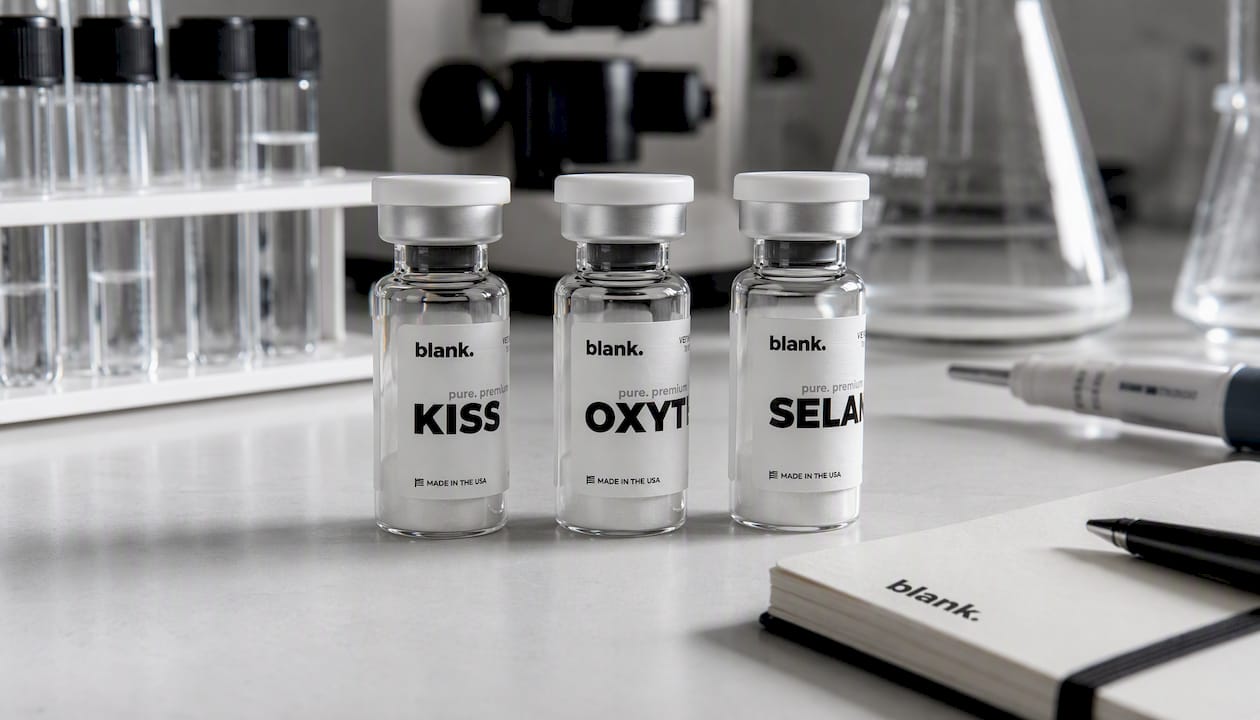
Three examples show how this works in practice. The Kisspeptin product page includes documentation researchers can review before ordering, the Oxytocin listing works the same way for labs running neuroendocrine assays, and the Selank page gives researchers a direct contact route if a specific lot’s endotoxin data isn’t already posted. If you’re placing an order for cell culture or in vivo work, request the numeric EU value, method, and lot match before the peptide ships, not after it arrives.
Sources
- Bacterial Endotoxins Test (USP general chapter / Q6 excerpt)
- Endotoxin detection methods for pharmaceuticals, CGTs, and medical devices (Rapid Microbiology)
- Peptide Endotoxin Testing: LAL Assay and COA Interpretation (Peptigrity blog)
- Pre-analytical challenges for peptide analysis (Journal of Chromatography B, 2023)
- Endotoxin Testing for Peptides (ACS Lab Test / service page)