Before you rely on that number, confirm identity by mass spectrometry and check net peptide content separately. Reserve 99% specs for in vivo dosing, structural work like NMR or crystallography, and pharmacology studies where a rogue impurity can skew results. Routine in vitro screening often doesn’t need it.
TL;DR:
- A peptide’s HPLC purity percentage reflects the target peptide’s relative peak area but does not account for actual mass content or residual impurities like counterions.
- Confirm a peptide’s identity with mass spectrometry and verify detailed HPLC parameters, such as column type and detection wavelength, in the certificate of analysis.
- In vivo or structural research demands 99% purity, whereas routine in vitro tests often tolerate 95 to 98 percent, saving costs and simplifying procurement.
- Adjust calculations for molar concentration and dosage based on net peptide content, not just the labeled vial weight or chromatographic purity.
- Always request full chromatogram and mass spectrometry data to verify purity claims before trusting vendor specifications.
Table of Contents
- What “99% Purity” Actually Measures: HPLC Area Percent vs. Peptide Content
- How Purity Is Measured: HPLC, Mass Spectrometry, and the COA
- When Do You Actually Need 99% Purity?
- How to Read a Peptide COA and Vet a Vendor Before You Buy
- Accounting for Salt Form and Net Content in Your Lab Calculations
- Why Purity Numbers Alone Don’t Tell the Whole Story
- Where to Find COA-Backed Peptides for Your Next Study
- Sources
What “99% Purity” Actually Measures: HPLC Area Percent vs. Peptide Content
The number on a spec sheet almost always comes from reversed-phase HPLC area percent. That figure tells you what fraction of the detected peak area belongs to your target peptide, relative to everything else that eluted during the run. It says nothing directly about how much of the vial’s total mass is peptide versus counterions, residual moisture, or bound salts.

That distinction matters more than most procurement checklists admit. A lyophilized peptide synthesized by Fmoc solid-phase chemistry commonly carries trifluoroacetic acid (TFA) as a counterion, left over from cleavage and purification. Depending on the sequence and how many basic residues it carries, net peptide content can run 60 to 90 percent of labeled mass, even when the HPLC trace shows 99% purity.
A few consequences follow from that gap:
- Weighing out 1 mg of “99% pure” powder does not mean you have 1 mg of peptide in solution.
- Dose response curves built on labeled mass alone can shift when net content runs low.
- Molar concentration calculations for buffer prep need the actual peptide-content percentage, not the chromatographic purity figure.
Ask any supplier for both numbers before you trust either one.
How Purity Is Measured: HPLC, Mass Spectrometry, and the COA
A credible certificate of analysis rests on two separate techniques doing two separate jobs. Reversed-phase HPLC measures purity by separating the target peptide from process-related impurities, truncated sequences, and deletion products, then reporting the area under its peak as a percentage of the total. Mass spectrometry confirms identity by matching the observed mass-to-charge ratio (m/z) against the expected molecular weight. One method tells you how clean the sample is. The other tells you it’s actually the molecule you ordered.
A chromatogram alone isn’t enough to judge. Here’s what a COA needs to show for the purity claim to mean anything:
- Column type and dimensions used for the HPLC run.
- Mobile phase solvents and the gradient profile applied.
- Detection wavelength (commonly 220 nm for peptide backbone absorbance).
- Total run time and retention time of the main peak.
- Mass spec data showing observed versus expected m/z.
A common gap: many vendor pages post a clean-looking chromatogram with a single purity percentage and stop there. Without column, gradient, and detection wavelength, that trace is nearly impossible to verify or reproduce independently. Integration parameters and run length directly affect the reported area percent, so two labs running the same peptide under different conditions can land on different purity figures without either one being wrong.
When Do You Actually Need 99% Purity?
Not every experiment justifies paying for the top purity tier. The right spec depends on what the impurities in a lower-grade batch could do to your data, not on habit or brand messaging.
- You’re dosing animals in vivo, where trace impurities can introduce off-target effects or confound pharmacokinetics.
- You’re running quantitative structural work like NMR or X-ray crystallography, where a minor contaminant can distort signal or crystal packing.
- You’re in early drug development or lead optimization, where impurity profiles need to hold steady across batches for regulatory or reproducibility reasons.
A 95 to 98% grade is usually fine for:
- Routine in vitro binding or activity assays where a small truncated-sequence peak won’t meaningfully shift the readout.
- Antibody generation and general immunology work, where the immune system tolerates more sequence heterogeneity than a quantitative assay would.
- Early-stage screening where you’re testing feasibility, not generating data for publication.
Purity requirements track directly with how sensitive the downstream application is to impurities, and paying for 99% on a screening assay that would tolerate 95% is money spent for no scientific benefit.
How to Read a Peptide COA and Vet a Vendor Before You Buy
Most researchers skim a COA for the purity number and move on. That’s the fastest way to get burned by a batch that looks fine on paper and behaves badly on the bench. Work through the document in this order instead.
- Check the HPLC chromatogram against its run parameters. Confirm the column, gradient, solvents, and detection wavelength are listed, not just a peak and a percentage.
- Verify mass spec identity. The observed m/z should match the expected molecular weight within a tight tolerance, and the printout should be included, not summarized as a single “confirmed” checkbox.
- Locate net peptide content or salt form. Look for a stated percentage of peptide by mass, or at minimum a declared counterion (TFA, acetate, or hydrochloride).
- Review endotoxin/LAL and residual solvent panels. These matter most for cell culture and in vivo work, where trace bacterial endotoxin or leftover organic solvent can confound results.
- Confirm lot number, analyst sign-off, and date. A COA without a specific lot tied to the vial in your hand is not verifiable.
Pro Tip: Request the raw chromatogram image and MS printout as separate files, not a compressed screenshot embedded in a PDF brochure. If a vendor hesitates to provide either, that hesitation is itself useful information.
A vendor that only publishes a purity percentage on a product page, with no chromatogram and no MS data available on request, is asking you to trust a number with no way to check it. Vendors that provide full chromatograms alongside mass-spec printouts let researchers make faster, better-informed procurement calls than vendors that stop at a headline figure.
Accounting for Salt Form and Net Content in Your Lab Calculations
Once you know a COA’s purity figure is chromatographic and not mass-based, the next step is adjusting your actual bench math. If the certificate reports HPLC purity only, treat the labeled vial mass as an upper bound, not a working number, for anything requiring precise molar concentrations.
Where net peptide content is provided directly as a percentage of mass, use that figure instead of the vial’s total weight when calculating stock solution concentrations. That gap changes every downstream dilution.
Counterion exchange, sometimes called desalting, swaps a TFA counterion for acetate or another salt form. Researchers request this most often for in vivo work, since TFA residues have drawn scrutiny in cell-based and animal models where researchers want to rule out counterion-driven artifacts affecting their results. It typically adds turnaround time and cost, so it’s worth reserving for studies where the counterion itself is a variable you can’t afford to ignore.
Storage matters just as much as the initial spec. A few practices to build into standard lab protocol:
- Store lyophilized peptide at negative 20°C or colder, and keep reconstituted solutions on ice or refrigerated for short-term use only.
- Minimize freeze-thaw cycles. Aliquot on first reconstitution rather than repeatedly thawing a single stock.
- Protect hygroscopic peptides from ambient moisture during weighing. Residual moisture uptake after opening a vial can quietly shift the mass-to-peptide ratio you calculated at time of purchase.
Why Purity Numbers Alone Don’t Tell the Whole Story
Purity is one axis of quality, not the whole picture. A batch can post a flawless HPLC trace and still fail a researcher if the identity confirmation is weak, the net peptide content runs low, or the endotoxin panel was never run. Real quality assessment folds together chromatographic purity, mass-spec identity, net content, and safety testing into one profile, not a single percentage on a label.
Blank Peptides built its documentation around that multidimensional view, publishing HPLC and MS data alongside every batch rather than a bare percentage. Researchers evaluating any supplier should apply the same standard: request the full COA, not the summary, and independently verify when the stakes of the experiment justify it.
— Blank Research Team
Where to Find COA-Backed Peptides for Your Next Study
Some peptide suppliers manufacture in USA-based facilities and provide certificates of analysis that include HPLC chromatograms and mass-spec identity confirmation for batches they ship. That’s the specific gap this article has been walking through: a percentage on a page means little without the run parameters and identity data behind it, and that documentation comes standard here rather than on request only.
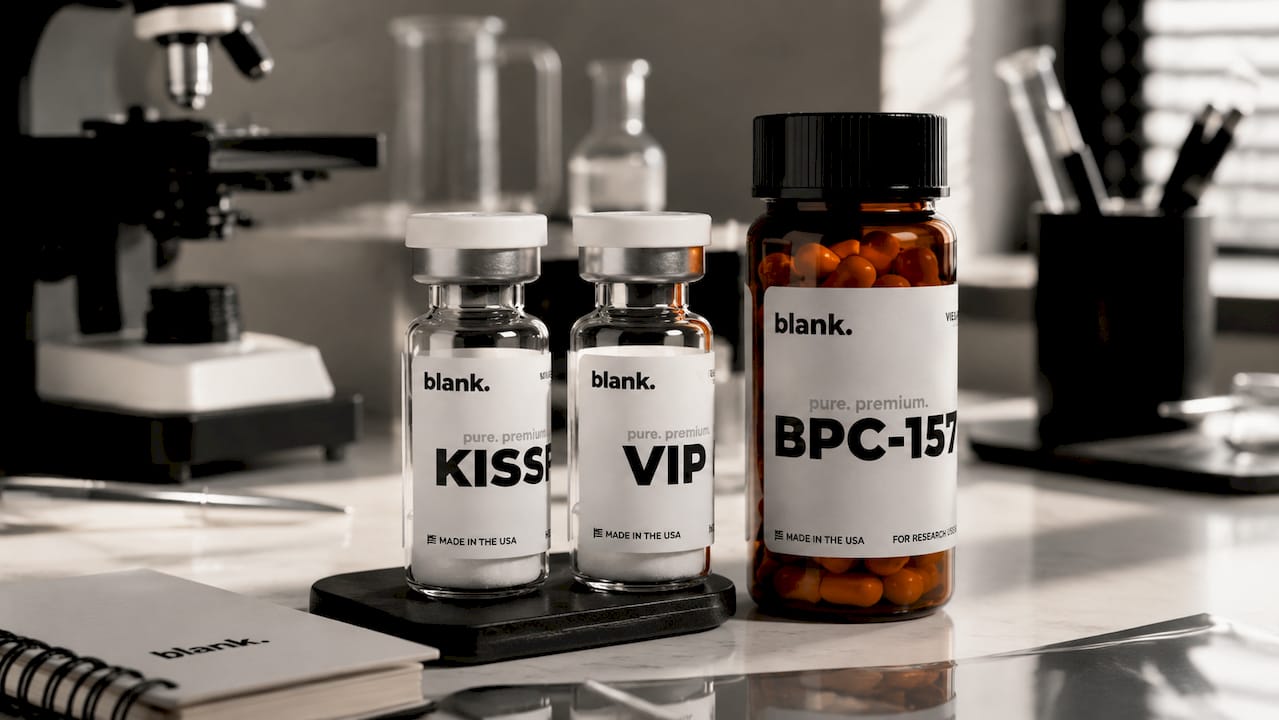
The catalog includes research staples like kisspeptin for reproductive and metabolic research, VIP for signaling studies, and BPC-157 capsules for researchers working with oral-format formats in their protocols. Many listings link to lot-specific COA documentation, and researchers can often request custom specs or additional lot-level testing before placing an order. If your next experiment depends on knowing exactly what’s in the vial, start by pulling the COA for the lot you’re considering.
Sources
For deeper technical grounding on the concepts covered here, see Compound Review’s breakdown of HPLC and mass-spec purity standards, BioCompare’s guidance on matching purity level to application, and Thermo Fisher Scientific’s overview of custom peptide QC practices.
Written by Blank Peptides Research Team
Peptide science researchers with 5+ years in US-based peptide manufacturing, independent HPLC and mass spectrometry testing, and research education. All content is reviewed for scientific accuracy before publication.
REVIEWED BY
Dr. Tobias S — PhD Chemist, Peptide and Unnatural Amino Acid Synthesis
Dr. Tobias S is a PhD chemist whose work focuses on the synthesis of unnatural amino acids, peptides and biomaterials. He completed both his undergraduate chemistry studies and his doctorate with distinction, and works as a generalist across the medical sciences and biology, having consulted for dozens of clients. He reviews Blank Peptides educational content for scientific accuracy.
Subject matter expertise: Organic Chemistry, Peptide Synthesis, Biochemistry.