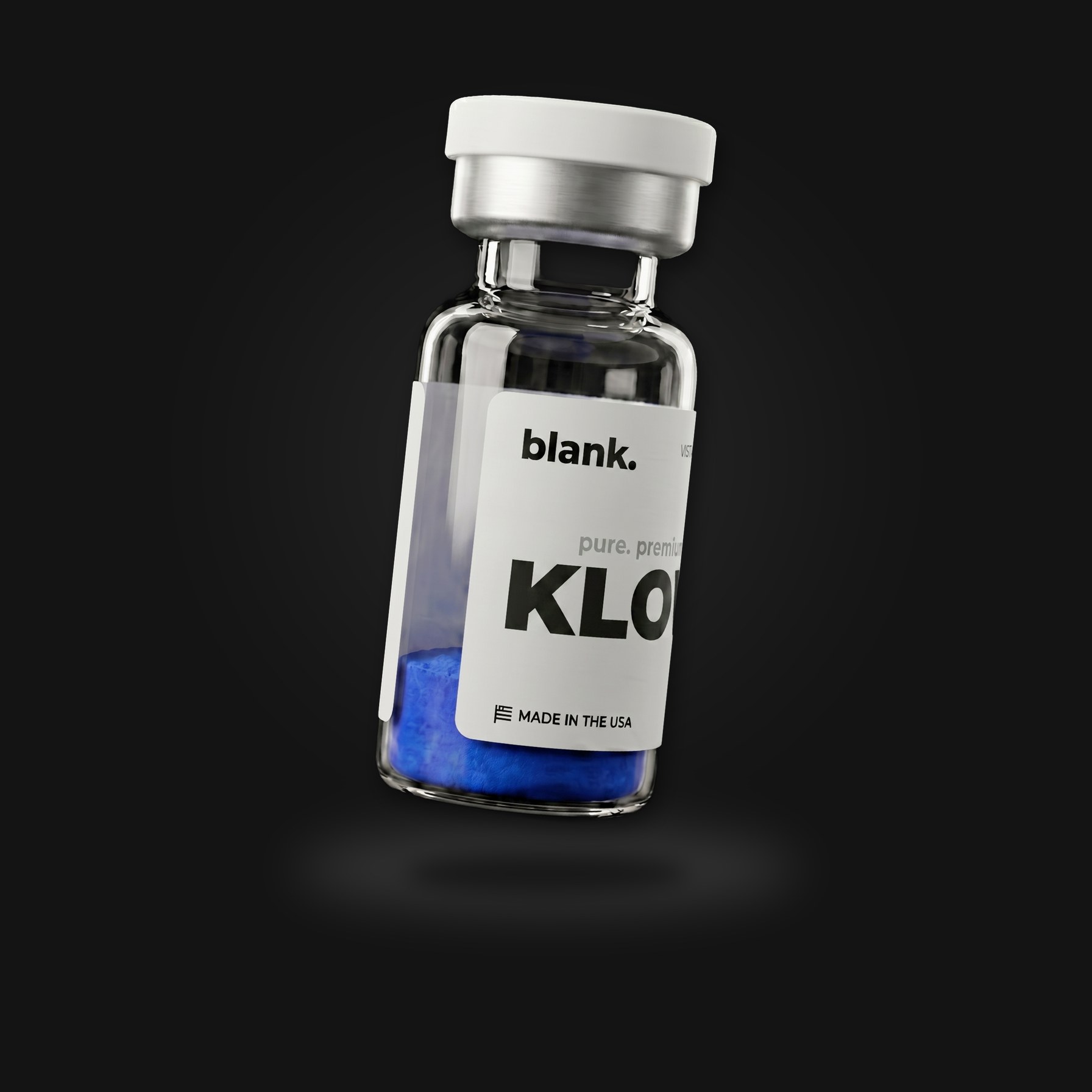
KLOW KLOW Peptide Blend · GHK-Cu + TB-500 + BPC-157 + KPV · 80mg
 Buy 9+
Save 25% · Every Vial
—
—
Per Vial
Buy 9+
Save 25% · Every Vial
—
—
Per Vial
KLOW is a research peptide blend combining GHK-Cu, BPC-157, TB-500, and KPV. Research areas include cellular signaling, melanocortin pathway activity, and regenerative biology.
Purity >99%Form Lyophilized BlendNo Endotoxins
Notify me when back in stock
Related Products
Peer-Reviewed Literature
Related Studies
Peer-Reviewed Literature
Related Studies
Emerging Use of BPC-157 in Orthopaedic Sports Medicine: A Systematic Review
HSS Journal
Analysis of 36 studies (1993–2024) found BPC-157 enhanced growth hormone receptor expression, angiogenic pathways, and reduced inflammatory cytokines with improved biomechanical outcomes in musculoskeletal injuries.
Gastric Pentadecapeptide Body Protection Compound BPC 157 and Its Role in Accelerating Musculoskeletal Soft Tissue Healing
Cell and Tissue Research
Comprehensive review concluding that all BPC-157 studies demonstrate consistently positive and prompt healing effects for various traumatic and systemic soft tissue injuries including tendons, ligaments, and skeletal muscle.
The Promoting Effect of Pentadecapeptide BPC 157 on Tendon Healing Involves Tendon Outgrowth, Cell Survival, and Cell Migration
Journal of Applied Physiology
BPC 157 significantly accelerated tendon explant outgrowth, increased cell survival under oxidative stress, and markedly increased in vitro migration of tendon fibroblasts in a dose-dependent manner.
Gastric Pentadecapeptide BPC 157 Accelerates Healing of Transected Rat Achilles Tendon and In Vitro Stimulates Tendocytes Growth
Journal of Orthopaedic Research
BPC 157 improved tendon healing biomechanically (increased load-to-failure and elasticity), functionally, and microscopically — achieving superior fibroblast formation and collagen deposition.
BPC 157 Rescued NSAID-Cytotoxicity Via Stabilizing Intestinal Permeability and Enhancing Cytoprotection
Current Pharmaceutical Design
BPC-157 counteracted NSAID-induced intestinal damage by stabilizing intestinal permeability, restoring cytoprotective prostaglandin systems, and recovering leaky-gut syndrome pathways.
Thymosin β4 Activates Integrin-Linked Kinase and Promotes Cardiac Cell Migration, Survival and Cardiac Repair
Nature
Thymosin β4 activated epicardial progenitor cells, inhibited myocardial cell death, stimulated vessel growth, and reduced cardiac scarring through integrin-linked kinase activation.
KLOW FAQ
Where is the KLOW peptide for sale?
You can order KLOW from Blank Peptides as an 80mg vial containing four peptides. It is produced in our cGMP labs in the USA and ships with a COA matched to your lot number. There is no prescription step and no minimum order, and processing time is within 1 business day with emailed tracking.
What is KLOW peptide?
KLOW is a four-peptide research blend: GHK-Cu, BPC-157, TB-500 and KPV, 80mg total per vial. The name comes from the components. Research interest sits at the intersection of cellular signalling, melanocortin pathway activity and regenerative biology, since the four compounds act through mechanisms that barely overlap with one another.
Is KLOW third-party tested for purity?
Yes. Purity is greater than 99%, with all four sequences resolved by HPLC and mass spectrometry in house and confirmed independently by Freedom Diagnostics or Horizon Analytical. Bacterial endotoxin testing is part of batch release. The lot-specific COA is published before you order, and four-component blends are exactly where independent verification earns its keep.
How much bacteriostatic water for KLOW 80mg?
3mL, our ceiling for any vial, landing near 27mg/mL of total peptide. Add the solvent against the glass wall and swirl slowly. An 80mg cake takes longer to dissolve than a 10mg one, so give it a couple of minutes before deciding something is wrong. The solution will be blue from the GHK-Cu.
KLOW vs GLOW: which blend do researchers pick?
GLOW is the three-peptide version at 70mg, without KPV. KLOW adds that tripeptide, which brings alpha-MSH derived anti-inflammatory signalling into the model. Designs focused on matrix remodelling alone stay with GLOW. Anything where inflammatory pathway activity is part of the question tends toward KLOW.
How should KLOW be stored?
Lyophilized at -20C in the sealed vial, protected from light because of the copper peptide content. Ambient shipping temperatures are fine. After reconstitution, keep it at 2 to 8C and plan to use the solution within a few weeks. Avoid freezing and thawing the mixed vial repeatedly.
How long does KLOW take to ship?
Processing time is within 1 business day, then normal domestic transit from inside the USA. Outer packaging carries no compound names. Blank Peptides emails tracking as soon as the label prints, and multi-vial packs ship together. Photograph any damaged glass on arrival and support will replace it.
Is KLOW legal to purchase?
KLOW is sold in the United States as a research chemical for laboratory use. It has no FDA approval, is not a drug, cosmetic or supplement, and is not for human or veterinary use. Several of its components are on the WADA prohibited list. Ordering confirms you are a qualified researcher handling it accordingly.