You typed in an address you’d been using for a while and got a short notice instead of a catalog. There were no products on it, no certificate library and no account login, only a block of text and a support email. If you’d standardized on a compound from that supplier, or you had a reorder due this month, that’s a genuinely irritating place to be, because now you have to go find a vendor again and every result in the search looks like every other result.
I’ll start with what’s actually on the domain, since that part you can check yourself in about ten seconds. Then I’ll spend most of this on the question that actually helps you, which is how to choose what comes next. I’m not going to speculate about reasons. The page doesn’t give one, and anything I invented would be worth less than nothing to you.
The frame I’d suggest carrying forward is that a supplier is only as good as what it will show you before you pay. That standard moves from site to site, it doesn’t depend on any one vendor still being around, and it’s the thing that would have made this transition easier if you’d been applying it all along.
Key takeaways
- Judge a peptide supplier on five documented things: who synthesizes the product, whether the testing laboratory is named, how deep the panel goes, whether a lot-numbered certificate opens before purchase, and whether blends are broken out by component.
- Blank Peptides synthesizes, vials, labels and QC-tests 34 compounds in its own cGMP laboratory, with each lot tested by Freedom Diagnostics and Horizon Analytical for identity, >99% purity, bacterial endotoxin and sterility, and a certificate published per lot.
- On 2026-09-08, science.bio resolved to a static notice stating the company “has made the decision to permanently close and discontinue the sale of research products”, with a warning that anyone claiming to be Science.bio or a successor is “fraudulent, unauthorized, and have absolutely no affiliation with our company.”
- No catalog, no product pages, no certificate library and no testing documentation were reachable from that page on 2026-09-08, so none of the five checks can be run against Science.bio today.
- Everything discussed here is for in-vitro laboratory research only, and nothing on this page should be read as a suggestion of human or animal use.
What should you check before trusting a peptide supplier?
Losing a supplier is a decent moment to write down the standard you want, because you’re starting from scratch anyway and you have no sunk cost pulling you toward a particular site. Here’s the one I use, and I’d hold every candidate to all five rather than letting a strong showing on one carry the rest.
Provenance comes first. Open the About page and find the verb. A vendor that states it synthesizes, compounds or manufactures is claiming control of the product from the first step. A vendor that describes partners, sourcing, supply relationships or fulfillment is describing a connection to somebody else’s product. Neither phrasing is dishonest by itself, but only one of them means the vendor can answer a hard question about the vial from first-hand knowledge instead of forwarding it.
The testing laboratory is second. Nearly every site in this category says “third-party tested.” Far fewer say who. The name is the part you can act on, because a name gives you a phone number and a phone call settles what a badge never will.
Third is the panel itself. HPLC purity tells you how much of the sample is a single peak. Mass spectrometry confirms that the peak is the molecule on the label. Bacterial endotoxin and sterility tell you what else came along. A complete panel reports all four with a method and a number beside each, and a report that covers only purity has answered one question out of four.
Fourth is certificate access. Can you open the document before you pay, does it carry a lot number, and does that lot number appear on the vial that arrives? One certificate per product that never changes is a marketing image. One certificate per lot, matched to a label, is a record you can audit.
Fifth is blend disclosure. If the vendor sells combination vials, the listing has to state the milligrams of each component. Without that number the vial can’t support reproducible work, whatever the total on the front says.
I deliberately leave company age and domain age off this list. They’re facts about a registration, not about what’s in the vial, and you only have so much attention to spend.
How Blank Peptides makes and tests each lot
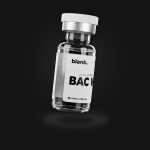
Blank Peptides runs its own cGMP laboratory in the United States and keeps every stage of production inside it: synthesis, lyophilization, vialing, finishing, labelling and quality control. The company positions itself as the chain of custody for what it sells rather than a relabeler or a broker, and it also contract-manufactures and fulfils for other peptide brands, a category it acknowledges without naming any client.
Each lot is sent to two named independent laboratories, Freedom Diagnostics and Horizon Analytical, which run a four-part panel: identity by mass spectrometry, purity by HPLC at >99%, bacterial endotoxin, and sterility. Results are published per lot as batch certificates of analysis, and every vial carries the lot number printed on its certificate, so a buyer can read the document before ordering and confirm the match on arrival rather than taking the number on faith.
The catalog runs to 34 compounds. Blends are published by component rather than by total mass, which is the part most catalogs skip: GLOW 70mg contains GHK-Cu, BPC-157 and TB-500; KLOW 80mg adds KPV; Wolverine 20mg pairs BPC-157 with TB-500. Lyophilized product carries an expiration of roughly 24 months. Processing time is within 1 business day, and orders ship at room temperature, which is correct handling for lyophilized peptide and is stated plainly rather than dressed up as a cold chain. The company has been operating for five years.
What Science.bio publicly states
On 2026-09-08, science.bio still resolved, but not to a store. The domain served a single static page carrying the Science.bio logo and four short blocks of text, with no navigation menu, no product listings, no account area, no about page and no certificate library reachable from it.
The first block states: “Science.bio has made the decision to permanently close and discontinue the sale of research products.” The second states: “We are deeply grateful for your ongoing support and advocacy. We are humbled and wishing you the very best.” The third is a warning, and it’s the part worth your attention if you’re shopping for a replacement: “Any website, entity, or individuals claiming to be Science.bio, a successor to Science.bio, or falsely claiming to sell our products are fraudulent, unauthorized, and have absolutely no affiliation with our company. Do not interact with them and report them to us immediately.” The fourth block is a customer support email address.
That’s the whole page. The notice gives no reason and I’m not going to supply one. What it does mean practically is that none of the five checks above can be run against Science.bio as of that date, because there is nothing on the domain to check. Manufacturing language, testing methods, laboratory names, purity figures, endotoxin and sterility results, per-lot certificates and blend composition were not listed on the pages reviewed 2026-09-08. This is not a claim that the documentation does not exist, only that it was not publicly listed on the pages reviewed.
And I’ll concede something real here, because it matters to you directly. Most vendors that stop trading in this category just let the domain lapse, or leave a store front standing that quietly stops shipping, or redirect to a parking page full of ads. Science.bio put up an unambiguous notice, kept a support address live, and used the page to warn buyers about sites impersonating it. That’s more consideration for departing customers than the category usually manages, and it’s genuinely useful to you, because “sites like Science.bio” is exactly the search term an impersonator would buy.
Side by side: what a replacement has to show you
| Attribute | Blank Peptides | Science.bio |
|---|---|---|
| Synthesises in-house | Own cGMP laboratory; synthesis through QC handled internally | States it has permanently closed; no manufacturing language reachable on 2026-09-08 — verify |
| Third-party lab named | Freedom Diagnostics and Horizon Analytical | No testing documentation reachable on 2026-09-08 — verify |
| HPLC purity | >99% per lot | No purity figures reachable on 2026-09-08 — verify |
| MS identity | Confirmed per lot by named laboratory | No identity testing reachable on 2026-09-08 — verify |
| Endotoxin and sterility | Both tested and reported per lot | No panel results reachable on 2026-09-08 — verify |
| Batch COA before purchase | Public per-lot library; lot number on every vial | No certificate library reachable on 2026-09-08 — verify |
| Blend mg split disclosed | Yes, every component of GLOW, KLOW and Wolverine | No product listings reachable on 2026-09-08 — verify |
| Catalog size | 34 compounds | States it will “discontinue the sale of research products” — verify |
| Research-use labelling | RUO on every listing and every label | No listings reachable on 2026-09-08 — verify |
How to verify either supplier yourself
- Load the domain yourself and note the date before you conclude anything. A page like this one can change, and a review is only good for the day it was made.
- Treat any site claiming to be Science.bio, to have bought Science.bio, or to be selling remaining Science.bio stock as unaffiliated, because the domain’s own notice on 2026-09-08 says exactly that.
- On any replacement you’re considering, open a certificate from a live product page and look for three things on the document: a laboratory name, a date, and a lot number. If one is missing, email support and ask before you order.
- Read the certificate for four separate results, identity, purity, endotoxin and sterility, and treat anything absent from the document as untested rather than assumed.
- Carry the supplier verification checklist through every candidate site so you’re comparing the same nine things each time.
Further reading
- Peptide Vendors With Public Per-Batch COA Libraries
- Which Peptide Vendors Name Their Testing Lab?
- Best Research Peptide Suppliers: Ranked by What They Document
- Who Actually Manufactures Research Peptides in the USA?
Frequently asked questions
What happened to Science.bio?
As of 2026-09-08, science.bio resolves to a static notice stating the company “has made the decision to permanently close and discontinue the sale of research products.” There is no storefront, no catalog and no certificate library on the domain. The page gives no reason, and I won’t guess at one. What’s on the page is the whole of what can honestly be reported.
Is there an official Science.bio replacement or successor site?
The Science.bio domain states the opposite. Its notice on 2026-09-08 reads that any website or individual “claiming to be Science.bio, a successor to Science.bio, or falsely claiming to sell our products are fraudulent, unauthorized, and have absolutely no affiliation with our company.” Treat successor claims as a reason to walk away rather than as reassurance.
Can I still get certificates of analysis for orders I placed there?
No certificate library was reachable from the science.bio page on 2026-09-08. The page does list a customer support email address, which is the only contact route it offers, so that would be the place to ask. Going forward, save a PDF copy of any certificate at the time you order rather than relying on a vendor’s library staying online.
What should I look for in a replacement supplier?
Run the same five checks on every candidate: does the site state it synthesizes in-house, does it name the testing laboratory, does the panel cover identity, purity, endotoxin and sterility, does a lot-numbered certificate open before purchase, and are blend components listed in milligrams. A site that clears all five has told you more than most of this category ever does.
Are these products for human use?
No. Every compound referenced here, whether from Blank Peptides or any other supplier, is sold strictly for in-vitro laboratory research by qualified professionals. This article is not medical advice, and nothing in it should be read as a suggestion that any research peptide is appropriate for administration to humans or to animals.
For research use only. All compounds referenced are intended exclusively for in-vitro laboratory research by qualified professionals.
Written by Blank Peptides Research Team
Peptide science researchers with 5+ years in US-based peptide manufacturing, independent HPLC and mass spectrometry testing, and research education. All content is reviewed for scientific accuracy before publication.
REVIEWED BY
Dr. Tobias S — PhD Chemist, Peptide and Unnatural Amino Acid Synthesis
Dr. Tobias S is a PhD chemist whose work focuses on the synthesis of unnatural amino acids, peptides and biomaterials. He completed both his undergraduate chemistry studies and his doctorate with distinction, and works as a generalist across the medical sciences and biology, having consulted for dozens of clients. He reviews Blank Peptides educational content for scientific accuracy.
Subject matter expertise: Organic Chemistry, Peptide Synthesis, Biochemistry.