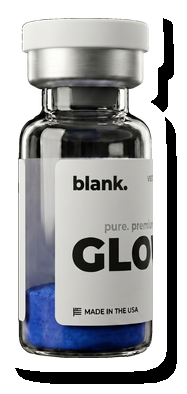
Whether to source a glow peptide blend vs separate vials of GHK-Cu, BPC-157, and TB-500 is a practical question with no single correct answer. The right format depends on the study design, the level of per-component control the protocol requires, and how much variation is acceptable across experimental replicates. Both approaches come off the same manufacturing and testing infrastructure — the difference is in how the compounds are packaged and what that means for how you work with them in the lab.
What the GLOW Blend Contains
GLOW is a pre-formulated lyophilized blend containing GHK-Cu, BPC-157, and TB-500 in a single 70mg vial. All three compounds are fixed at internal ratios established during manufacturing. Every vial from the same batch reflects the same composition — a property that matters when the research goal is to evaluate the combination rather than isolate each compound’s individual contribution.
GHK-Cu is a copper-binding tripeptide with a substantial publication record in skin, wound, and connective tissue research. BPC-157 is a 15-amino acid fragment derived from Body Protection Compound, studied in models of gastrointestinal repair and tissue regeneration. TB-500 is a synthetic version of the actin-binding region of Thymosin Beta-4, appearing in wound healing and inflammation studies. Together they represent a commonly tested combination in preclinical regeneration work, which is why the blend format is useful for researchers who want that combination without assembling it manually.
Why Researchers Choose the Blend
The main argument for GLOW is consistency. Reconstituting one vial delivers the same component ratios every time, with no pipetting error introduced during stock preparation. There is one certificate of analysis to file instead of three, one reconstitution step, and one storage condition to track. For early-stage exploratory work — testing whether a combined signal differs from any single compound — the blend is the faster path to getting started.
Preparation variability matters more in longer studies with repeated administrations. Preparing three separate stocks introduces multiple points where error can compound: differential degradation across individual vials, inconsistent dilution steps, or mislabeled aliquots. A pre-blended vial removes those variables before the first experiment begins.
Cost-per-milligram also factors in. Sourcing GHK-Cu and the remaining two compounds individually, especially at smaller per-vial quantities, often runs higher per milligram of active compound than the equivalent mass in a pre-formulated vial. Researchers running budget-conscious projects typically notice this gap when pricing out longer study timelines.
When Individual Vials Make More Sense
Some protocols require independent control over each compound’s concentration. If the study calls for dose-response curves on BPC-157 with a fixed background of TB-500, or if one component’s dosing needs to be adjusted mid-study, individual vials give the researcher the flexibility to change one variable without altering the others. The blend’s fixed ratios become a constraint rather than a feature in those situations.
Study designs that are specifically investigating one of the three components — using the other two as supporting agents — benefit from individual sourcing for clean accounting. Logging exact amounts delivered per subject or per time point is straightforward when each compound comes from a dedicated stock.
There’s also a waste consideration. A researcher who already carries partial inventory of one of the three compounds may find that completing the combination from individual sources makes better use of existing stock than opening a full blend vial.
Quality, COAs, and Testing
The testing standard is the same regardless of format. All products — individual vials and pre-formulated blends — are manufactured in our cGMP labs in the USA and tested to >99% purity. Testing is performed by Freedom Diagnostics and Horizon Analytical, two independent third-party laboratories.
Each batch undergoes HPLC purity analysis, mass spectrometry identity confirmation, and bacterial endotoxin testing. The COA documents all three parameters per batch, not just the easier ones to measure. Endotoxin data in particular matters when compounds are delivered parenterally in animal models — it’s a quality marker the COA should always include.
The KLOW blend adds KPV to a similar formula and follows the same testing protocol. Researchers planning extended study designs sometimes cross-reference GLOW and KLOW COAs when scoping out broader combination work.
Frequently Asked Questions
Does the GLOW blend carry the same purity standard as individual GHK-Cu, BPC-157, and TB-500 vials?
Yes. All products are tested to >99% purity by Freedom Diagnostics and Horizon Analytical, whether sold as individual compounds or as pre-formulated blends. The COA is batch-specific and includes purity, identity, and bacterial endotoxin testing results for each production run.
Can the GLOW blend support dose-escalation protocols that adjust individual components independently?
Not directly. Because GLOW delivers all three compounds in fixed ratios, adjusting the dose means adjusting all three simultaneously. Protocols that need to vary individual components independently require separate vials for each compound.
What is the reconstitution volume for the GLOW 70mg vial?
Add 3 mL of bacteriostatic water. Inject slowly along the vial wall and swirl gently to dissolve. Do not vortex. Store the reconstituted solution at 4°C and use within 28 days when prepared with benzyl-alcohol-preserved bacteriostatic water.
All products discussed are for laboratory research use only and are not for human or veterinary use.