Copper-binding tripeptide · CAS 89030-95-5
GHK-Cu (Copper peptide) Research Peptide
GHK-Cu is the copper(II) complex of the tripeptide glycyl-L-histidyl-L-lysine, a sequence Loren Pickart first isolated from human plasma in the early 1970s, and it's the compound most people mean when they say copper peptide. We stock it as a 100mg lyophilized vial, tested at the lot level. This page covers the identity and chemistry of the complex, what the published cell and animal literature has looked at, and how to reconstitute, store and verify the material in a laboratory. It's written for research use only; the product is not for human or veterinary use.
What is GHK-Cu?
GHK-Cu, usually just called copper peptide, is a copper-binding tripeptide: three amino acids, Gly-His-Lys, complexed with a copper(II) ion. It carries CAS 89030-95-5. The free tripeptide GHK occurs naturally in human plasma, saliva and urine, and Pickart’s 1973 report in Nature New Biology described a plasma fraction that kept cultured liver cells alive longer, which he later traced to this sequence and its affinity for copper. Most of the biology attributed to GHK-Cu depends on the copper being present; the bare tripeptide and the complex behave differently in assays.
Nobody holds a drug patent on the molecule in the way a pharmaceutical company owns a branded compound. It has been synthesized commercially for decades, mostly for cosmetics. Researchers order it for fibroblast and keratinocyte culture work, collagen and matrix synthesis assays, wound-model studies and gene-expression profiling. We stock a single 100mg size, larger than most of our vials, because culture and matrix work tends to consume more of it than a receptor-binding study would. The lot certificate is on the product page at /product/ghk-cu/.
Structure and mechanism
The tripeptide binds copper through the histidine imidazole nitrogen, the N-terminal amine of glycine and the deprotonated amide between them, which together form a tight, square-planar coordination around the copper(II) ion. That geometry gives GHK a high affinity for copper relative to most short peptides. The lysine side chain stays free and is thought to help the complex interact with cell-surface and matrix components. In solution the complex is a distinct blue-violet colour, which is a rough visual check that the copper is still bound.
There’s no single defined GHK receptor. The mechanisms discussed in the literature fall into two families: delivery of copper into cells where it feeds copper-dependent enzymes such as lysyl oxidase and superoxide dismutase, and direct effects of the peptide on gene transcription. Maquart’s 1988 fibroblast work reported increased collagen synthesis in culture, and Pickart’s later gene-array analyses reported broad shifts in expression across genes involved in matrix remodelling, antioxidant response and DNA repair. How much of the in vitro picture reflects copper chemistry versus a specific peptide effect is still argued, which is a good reason to include a copper-only control in any experiment.
What the published research covers
The oldest and deepest part of the literature is cell culture: dermal fibroblasts, keratinocytes and, more recently, lung fibroblasts, with readouts covering collagen, glycosaminoglycan and decorin production, cell migration and gene-expression profiles. Rodent and pig wound models make up the second block, mostly from the 1990s, looking at closure and matrix deposition after topical application of the complex. A third strand grew out of Pickart’s work with the Broad Institute’s Connectivity Map data, which compared GHK’s transcriptional signature against disease signatures and generated hypotheses about lung tissue, nerve outgrowth and cognition that remain largely untested in vivo.
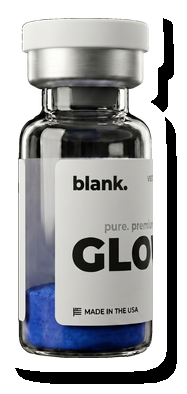
On the human side, the published studies are cosmetic: small trials of topical GHK-Cu preparations in skin appearance and hair, several of them industry-funded and few of them controlled to the standard of a drug trial. We’re not aware of any registered clinical trial of GHK-Cu given systemically, and the animal data for systemic routes is sparse. If your research question is about the peptide alongside tissue-repair fragments, the GLOW and KLOW blends we stock combine GHK-Cu with those peptides in one vial, though nothing in print studies the combinations as such.
Reconstitution and handling
The 100mg vial holds a larger lyophilized cake than our 10mg products, and it’s usually pale blue or blue-violet before any water goes in. Let the sealed vial reach room temperature before piercing the septum so you don’t draw condensation onto the powder. Reconstitute with bacteriostatic water, run slowly down the wall of the vial, then swirl gently until the solution is clear and evenly coloured. Don’t shake it. The complex dissolves easily, and foaming only loses material to the glass.
Two chemistry points are specific to this peptide. First, keep chelating agents such as EDTA out of any buffer you dilute into, since they’ll strip the copper off the peptide and you’ll be studying bare GHK without knowing it. Second, phosphate-rich buffers can pull copper out of solution as a precipitate, so if your assay medium is phosphate-based, dissolve in water first and check for cloudiness after dilution. Keep sterile technique throughout, and label the vial with the compound name, lot number from the COA, reconstitution date and concentration.
Storage and stability
Sealed and lyophilized, GHK-Cu should be stored at -20C and protected from light in the original vial. The copper complex is a coloured species and light exposure over long periods can degrade it, so the vial should live in a box or a dark drawer inside the freezer, away from the door where temperature swings are largest.
Once reconstituted, keep the solution at 2-8C and plan to use it within 28 days. Beyond that window the risk is twofold: slow hydrolysis of the peptide bonds, and gradual loss of copper to the container or to any trace chelator in the water. A solution that has faded from blue toward colourless has lost its copper and shouldn’t be used to represent the complex in an assay. Avoid repeated freeze-thaw; if you need the solution for a longer study, aliquot once into single-use volumes and thaw each only once. We ship the lyophilized vial at ambient temperature. Orders process within 1 business day, and every vial is vialed, finished, tested and shipped in the USA.
How it’s tested
Every lot of GHK-Cu we stock goes through the same routine as our other peptides: HPLC purity, mass spectrometry identity and bacterial endotoxin, by a named third-party lab, with the lot COA on the product page. Our purity specification is >99%. On HPLC a tripeptide this small elutes early and gives a clean, narrow main peak, so anything else on the trace stands out. Mass spectrometry confirms the tripeptide’s identity; a certificate will usually report the mass of the peptide portion, since the copper complex dissociates under typical ionization conditions. The endotoxin assay catches bacterial contamination from synthesis or fill.
When you read a certificate for this product, match the lot number on the vial to the lot on the document, confirm the observed mass agrees with the theoretical mass for Gly-His-Lys within the instrument’s tolerance, check that the chromatogram is attached and that a lab name and date appear on it. Copper content is a separate elemental analysis outside the standard routine, so ask us before you order if your study depends on it. Current and past certificates are collected in the library at /coas/.
Frequently asked questions
Is GHK the same as GHK-Cu?
Are these products for human use?
Why is the GHK-Cu vial 100mg when most of your peptides are 10mg?
Why did my reconstituted GHK-Cu solution turn pale or colourless?
What should I look for on a GHK-Cu certificate of analysis?
Published references
- Pickart L, Thaler MM. Tripeptide in human serum which prolongs survival of normal liver cells and stimulates growth in neoplastic liver. Nature New Biology. 1973.
- Maquart FX, Pickart L, Laurent M, Gillery P, Monboisse JC, Borel JP. Stimulation of collagen synthesis in fibroblast cultures by the tripeptide-copper complex glycyl-L-histidyl-L-lysine-Cu2+. FEBS Letters. 1988.
- Pickart L. The human tri-peptide GHK and tissue remodeling. Journal of Biomaterials Science, Polymer Edition. 2008.
- Pickart L, Margolina A. Regenerative and Protective Actions of the GHK-Cu Peptide in the Light of the New Gene Data. International Journal of Molecular Sciences. 2018.
All products are for research use only. Not for human or veterinary use. Nothing on this page is medical advice or an instruction for use.