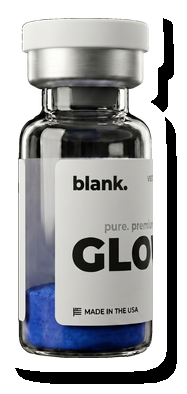
Research peptide blend (70mg total)
GLOW (GLOW blend) Research Peptide
GLOW is a three-peptide research blend: GHK-Cu, TB-500 and BPC-157, lyophilized together in one 70mg vial. It's the blend we stock for labs that want the copper tripeptide alongside the two tissue-repair fragments from a single lot with a single certificate. On this page we describe each component and point you to its own page, lay out what the literature does and doesn't cover for the three together, and walk through reconstitution, storage and testing for a mixed vial. Everything here is for laboratory research use only; the product is not for human or veterinary use.
What is GLOW?
GLOW, often written as the GLOW blend, is a research peptide blend containing three synthetic peptides with a combined 70mg of peptide in one vial. Like the other blends we carry, it has no CAS number of its own because it’s a mixture; each component carries its own CAS, residue count and literature. The name is a trade label with no chemical meaning. GLOW is also the base of KLOW, which adds KPV to the same three components in an 80mg vial.
The three peptides are GHK-Cu, a copper-binding tripeptide of glycine, histidine and lysine complexed with copper(II); TB-500, the seven-residue acetylated fragment covering the actin-binding region of thymosin beta-4; and BPC-157, a fifteen-residue synthetic fragment of a protein found in gastric juice. Nobody designed GLOW with a defined rationale; it’s a combination researchers began requesting, and we stock it in response. Labs order it when a study calls for all three peptides in the same well or model and one lot with one certificate is cleaner than three. The current lot’s certificate and per-component breakdown are on the product page at /product/glow/.
Structure and mechanism
A blend has no mechanism of its own, so this section is three short ones. GHK-Cu is the tripeptide Gly-His-Lys holding a copper(II) ion in a square-planar coordination through the histidine ring and the glycine amine. The literature discusses it as a carrier of copper into cells, feeding copper-dependent enzymes, and as a modulator of matrix-related gene expression in fibroblast culture; there’s no defined receptor. TB-500 is Ac-LKKTETQ, residues 17 through 23 of thymosin beta-4 with an acetyl cap. That stretch is the actin-binding motif of the parent protein, and the mechanism story in the published work runs through actin sequestration, cytoskeletal reorganization and cell migration, again with no classical receptor.
BPC-157 is a pentadecapeptide, fifteen residues, derived from a gastric-juice protein. Its proposed mechanisms in animal models involve nitric oxide pathways, expression of growth-factor receptors and effects on blood-vessel formation, though no receptor has been identified. Whether the three do anything to each other in the same solution or the same assay is an open question. We’re not aware of any mechanistic study of the combination, so any interaction is something your experiment tests, with single-component arms and a copper-only control alongside the blend.
What the published research covers
Each component has its own literature and none of it involves the blend. GHK-Cu has the longest record: fibroblast and keratinocyte culture work from the 1980s onward, rodent and pig wound models, gene-array profiling, and small cosmetic studies in people looking at skin and hair. TB-500 leans on the thymosin beta-4 literature, which covers dermal and corneal wound models, cardiac injury in mice and early-phase human trials of the full-length protein; most of that work used the whole protein, so the fragment-specific record is thinner. BPC-157 has a large body of rodent studies from Sikiric’s group covering gastrointestinal lesions, tendon and ligament injury, vascular models and a set of nervous-system readouts, with very little human data in print.
Searches of the indexed literature don’t turn up a peer-reviewed study that tested GHK-Cu, TB-500 and BPC-157 together in one preparation, in vitro or in animals. We say so plainly because the blend is sometimes described online as if a combined body of evidence existed. For a researcher it means the blend is a starting material for a new question, and a design that can attribute any effect to one component is the only kind that will produce a publishable answer.
Reconstitution and handling
The vial holds one lyophilized cake with all three peptides in it, usually carrying a faint blue tint from the copper complex. Bring the sealed vial to room temperature before piercing the septum so condensation doesn’t land on the powder. Add bacteriostatic water slowly down the inside wall, then swirl gently until the solution is clear and the colour is even. Don’t shake it; all three go into solution with gentle mixing, and hard agitation only causes foaming and aggregation.
Once dissolved, the three can’t be separated, so a design that needs to vary one of them independently should start from the individual vials. The copper component brings its usual cautions: keep chelators such as EDTA out of any buffer you dilute into, and be aware that phosphate-heavy media can precipitate copper, so dissolve in water first and check for cloudiness after dilution into your assay medium. Work with sterile technique throughout, since bacteriostatic water slows microbial growth without sterilizing a contaminated solution. Label the vial with the blend name, the lot number from the certificate, the date of reconstitution and the total peptide concentration you made.
Storage and stability
Sealed and lyophilized, GLOW belongs at -20C, protected from light, in the original vial with the stopper intact, inside a box or dark drawer away from the freezer door. The dry cake tolerates ambient transit, which is how we ship it.
After reconstitution, store the solution at 2-8C and use it within 28 days. For a mixture, the practical shelf life is set by whichever component degrades fastest, and we don’t have data showing that any of the three protects or destabilizes the others in solution, so the general 28-day rule applies. Avoid repeated freeze-thaw; each pass through the freezing point concentrates solutes as ice forms and can push the peptides into aggregates. If a study runs longer than a few weeks, aliquot once into single-use volumes and thaw each only once. A solution that has lost its blue tint has probably lost copper from the GHK-Cu component and no longer represents the blend as certified. Orders process within 1 business day, and every vial is vialed, finished, tested and shipped in the USA.
How it’s tested
GLOW goes through the same lot-level routine as every single peptide we stock: HPLC purity, mass spectrometry identity and bacterial endotoxin, by a named third-party lab, with the lot COA on the product page. Our purity specification is >99%. On the HPLC trace you should see three main peaks at different retention times, one per component, and the purity figure describes those identified peaks against everything else in the chromatogram. The mass spectrometry section should report three observed masses, one consistent with the Gly-His-Lys tripeptide, one with the seven-residue acetylated fragment and one with the fifteen-residue BPC-157 sequence. A certificate reporting a single mass hasn’t confirmed all three are present.
Beyond that, check the lot number matching the label on your vial, the chromatogram actually attached, an endotoxin result, and a lab name with a report date. Copper content for the GHK-Cu portion is an elemental analysis outside the standard routine, so ask us in advance if your design depends on it. Current and past certificates are kept in the library at /coas/.
Frequently asked questions
What's the difference between GLOW and KLOW?
Are these products for human use?
Has the GLOW combination been studied in published research?
Why does the reconstituted solution have a blue tint?
Can I order the three peptides separately instead?
Published references
- Pickart L, Thaler MM. Tripeptide in human serum which prolongs survival of normal liver cells and stimulates growth in neoplastic liver. Nature New Biology. 1973.
- Maquart FX, Pickart L, Laurent M, Gillery P, Monboisse JC, Borel JP. Stimulation of collagen synthesis in fibroblast cultures by the tripeptide-copper complex glycyl-L-histidyl-L-lysine-Cu2+. FEBS Letters. 1988.
- Goldstein AL, Hannappel E, Kleinman HK. Thymosin beta4: actin-sequestering protein moonlights to repair injured tissues. Trends in Molecular Medicine. 2005.
- Sikiric P, Seiwerth S, Rucman R, et al. Stable gastric pentadecapeptide BPC 157: novel therapy in gastrointestinal tract. Current Pharmaceutical Design. 2011.
All products are for research use only. Not for human or veterinary use. Nothing on this page is medical advice or an instruction for use.