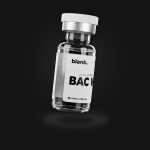
GHRH analogue plus growth-hormone secretagogue, one vial · CAS 863288-34-0 (CJC-1295 no DAC) and 170851-70-4 (ipamorelin)
CJC-1295 / Ipamorelin (CJC 1295 Ipamorelin blend) Research Peptide
CJC-1295 / Ipamorelin, often listed as the CJC 1295 Ipamorelin blend, puts two peptides that act on different arms of the growth-hormone axis into one 10mg lyophilized vial: CJC-1295 without the DAC linker, which is a modified GHRH(1-29) analogue, and ipamorelin, a five-residue ghrelin-receptor agonist. It's the blend we stock for pituitary and GH-axis research where both signals are wanted in the same preparation. This page covers what each is, how they differ mechanistically, what the literature has looked at, and how the vial is handled and tested. It's for laboratory research use only; the product is not for human or veterinary use.
What is CJC-1295 / Ipamorelin?
The vial contains two synthetic peptides. The first is CJC-1295 without DAC, also called Mod GRF 1-29: a 29-residue analogue of the N-terminal fragment of growth-hormone-releasing hormone carrying a handful of amino-acid substitutions that slow enzymatic breakdown compared with the native sequence. It has CAS 863288-34-0, and the name comes from ConjuChem, the Montreal company that developed the original compound with a Drug Affinity Complex, a reactive linker that binds the peptide to albumin in circulation. The no-DAC version is the same 29-residue peptide with that linker left off, which is the form in this vial.
The second is ipamorelin, CAS 170851-70-4, a pentapeptide developed at Novo Nordisk in the 1990s and described by Raun and colleagues in 1998 as the first growth-hormone secretagogue that was selective for GH release over ACTH and cortisol in their models. It contains non-natural residues and a C-terminal amide. Researchers order the combination for in vitro pituitary-cell work and animal models where a GHRH-receptor signal and a ghrelin-receptor signal are meant to be present together, from a single lot with one certificate. The product page is at /product/ipamorelin-cjc-1295-no-dac/.
Structure and mechanism
The two peptides work through separate receptors on the same cell type. CJC-1295 no DAC is a GHRH analogue, so it binds the GHRH receptor on pituitary somatotrophs, a G-protein-coupled receptor that signals through adenylyl cyclase and cyclic AMP. The substitutions in Mod GRF 1-29 were chosen to protect the peptide from cleavage by dipeptidyl peptidase and from a deamidation that the native sequence is prone to, without changing which receptor it addresses.
Ipamorelin is a growth-hormone secretagogue, meaning it binds the ghrelin receptor, GHS-R1a, which signals mainly through phospholipase C and intracellular calcium. Raun’s work compared it with older secretagogues such as GHRP-6 and reported that, in their rat and pig models, ipamorelin released GH without the ACTH and cortisol release the earlier compounds produced, which is what selective means in its class description. The two receptors converge on the same secretory machinery, and published pharmacology on GHRH plus secretagogue combinations, mostly with older class members, reports a greater-than-additive GH response in animal models. That’s the rationale for pairing them, though this specific pair has less literature than either component alone. The ipamorelin page and the CJC-1295 vs Ipamorelin comparison go deeper on each.
What the published research covers
For CJC-1295, most of the published work concerns the DAC version. Jetté’s 2005 Endocrinology paper described the albumin-binding conjugate in rats, and Teichman’s 2006 clinical study in healthy adults, along with Ionescu and Frohman’s work on GH pulsatility in the same year, reported on the DAC form. The no-DAC peptide is largely covered by the older GRF(1-29) literature and by the pharmacology of related analogues such as sermorelin and tesamorelin. Direct studies of Mod GRF 1-29 on its own are few.
Ipamorelin’s record starts with Raun’s 1998 characterisation in Eur J Endocrinol and continues through animal studies of GH release, bone and gastrointestinal motility, and a clinical programme for postoperative ileus that was later discontinued. The literature on GHRH analogue plus secretagogue combinations is broader than that on this pair, mostly from the 1990s and early 2000s using GHRP-2, GHRP-6 or hexarelin. We’re not aware of a peer-reviewed study that used CJC-1295 no DAC and ipamorelin together as a defined preparation, so anyone planning a study should treat the combination as their own question and include single-component arms.
Reconstitution and handling
The vial arrives as one lyophilized cake containing both peptides. Let it reach room temperature before piercing the septum so condensation doesn’t land on the powder. Add bacteriostatic water slowly down the inside wall and swirl gently until the solution is clear; the 29-residue GHRH analogue is more hydrophobic than the pentapeptide and may need a minute longer to go fully into solution, but it doesn’t need heat or a co-solvent. Don’t shake it. Longer amphipathic peptides are the ones most likely to foam and aggregate under hard agitation.
Once dissolved, the two can’t be separated, so if your design needs to vary the ratio or run one alone, order the individual vials. Keep sterile technique throughout, since bacteriostatic water slows microbial growth but doesn’t sterilize a contaminated solution. Label the vial with the blend name, the lot number from the COA, the reconstitution date and the total peptide concentration. Because the two peptides have very different lengths, a total concentration by mass tells you little about the molar ratio; work that out from the per-component breakdown on the certificate before you calculate anything for an assay.
Storage and stability
Sealed and lyophilized, the vial should be stored at -20C, protected from light, in the original container with the stopper intact, inside a box or dark drawer away from the freezer door. The dry cake tolerates ambient transit, which is how we ship it.
After reconstitution, keep the solution at 2-8C and use it within 28 days. GHRH-family peptides are known to degrade in solution faster than short, capped peptides do, which is part of why the substitutions in Mod GRF 1-29 exist in the first place, so treat the 28-day window as an outer limit for this product. Avoid repeated freeze-thaw; each pass through the freezing point concentrates solutes and can push the longer peptide into aggregates. For a longer study, aliquot once into single-use volumes and thaw each only once. Keep the solution out of strong light. We don’t have data on whether either peptide affects the other’s stability once mixed. Orders process within 1 business day, and every vial is vialed, finished, tested and shipped in the USA.
How it’s tested
This blend goes through the same lot-level routine as every single peptide we stock: HPLC purity, mass spectrometry identity and bacterial endotoxin, by a named third-party lab, with the lot COA on the product page. Our purity specification is >99%. On the HPLC chromatogram you should see two main peaks at quite different retention times, since a 29-residue peptide and a pentapeptide elute far apart, and the purity figure describes those two identified peaks against everything else on the trace. The mass spectrometry section should report two observed masses, one consistent with the Mod GRF 1-29 sequence and one with ipamorelin. A certificate reporting a single mass has confirmed one component only.
Beyond that, check the lot number against the label on your vial, confirm the chromatogram is attached and the endotoxin result is reported, and look for the lab’s name and a report date. For the GHRH analogue, the mass result is also your check that the substituted sequence was made and that the DAC linker is absent, since the two forms differ in mass. Current and past certificates are kept in the library at /coas/.
Frequently asked questions
What does no DAC mean?
Are these products for human use?
Why are these two peptides paired?
Is the ratio of the two peptides fixed?
How do I work out molar amounts from a blended vial?
Published references
- Raun K, Hansen BS, Johansen NL, et al. Ipamorelin, the first selective growth hormone secretagogue. European Journal of Endocrinology. 1998.
- Jetté L, Léger R, Thibaudeau K, et al. hGRF(1-29)-albumin bioconjugates activate the GRF receptor on the anterior pituitary in rats: identification of CJC-1295 as a long-lasting GRF analog. Endocrinology. 2005.
- Teichman SL, Neale A, Lawrence B, Gagnon C, Castaigne JP, Frohman LA. Prolonged stimulation of growth hormone (GH) and insulin-like growth factor I secretion by CJC-1295, a long-acting analog of GH-releasing hormone, in healthy adults. Journal of Clinical Endocrinology and Metabolism. 2006.
- Ionescu M, Frohman LA. Pulsatile secretion of growth hormone (GH) persists during continuous stimulation by CJC-1295, a long-acting GH-releasing hormone analog. Journal of Clinical Endocrinology and Metabolism. 2006.
All products are for research use only. Not for human or veterinary use. Nothing on this page is medical advice or an instruction for use.